

29th Sep 2022 Shift 2 All PYQ’s of UGC NET/JRF Unit 4 Business Finance Commerce Subject:
1. Question
Match List I with List II:
| List I – Type of Exposure | List II – Description | ||
| (A) | Economic Exposure | (I) | Potential changes in all future cash flows of a firm that result from unanticipated changes in exchange rates. |
| (B) | Translation Exposure | (II) | It arises when items of financial statements that are stated in foreign currencies are restated in the home currency of an MNC. |
| (C) | Transaction Exposure | (III) | It arises when a firm’s contract obligations are exposed to unanticipated changes in exchange rate. |
| (D) | Operating Exposure | (IV) | When a firm’s real assets are exposed to unanticipated changes in exchange rates. |
Choose the correct answer from the options given below:
- (A) – (III), (B) – (IV), (C) – (II), (D) – (I)
- (A) – (I), (B) – (II), (C) – (III), (D) – (IV)
- (A) – (IV), (B) – (III), (C) – (II), (D) – (I)
- (A) – (I), (B) – (IV), (C) – (III), (D) – (II)
Solutions:
Key Points
Economic exposure, also sometimes called operating exposure, is a measure of the change in the future cash flows of a company as a result of unexpected changes in foreign exchange rates (FX). Economic exposure cannot be easily mitigated because it is caused by the unpredictable volatility of currency exchange rates.
Translation exposure (also known as translation risk) is the risk that a company’s equities, assets, liabilities, or income will change in value as a result of exchange rate changes. When a firm denominates a portion of its equities, assets, liabilities, or income in a foreign currency, translation risk occurs.
Transaction exposure, defined as a type of foreign exchange risk faced by companies that engage in international trade, exists in any worldwide market. It is the risk that exchange rate fluctuations will change the value of a contract before it is settled. This exposure pertains to the exposure due to an actual transaction taking place in business involving foreign currency. This can also be called transaction risk.
Operating exposure refers to how exchange rate changes can impact on a firm’s future cash flows and consequently affect the firm’s value. The cash flows may be contractual or anticipated.
2. Question
Which of the following are key assumptions of Gordon’s Dividend Model?
(A) Ke > br
(B) r and Ke are changing
(C) The firm is not all-equity firm
(D) The firm has perpetual life
(E) The retention ratio, once decided, is constant
Choose the correct answer from the options given below:
- (A), (D), (E) only
- (B), (C), (E) only
- (A), (B), (D) only
- (C), (D), (E) only
Solutions:
The correct answer is (A), (D) (E) only
Key Points
According to Gordon’s Model, the dividend decision of a firm affects its value and the market value of the share is equal to the present value of its expected future dividends.
P = [E (1-b)] / Ke – br
Where, P = price of a share
E = Earnings per share
b = retention ratio
1-b = proportion of earnings distributed as dividends
Ke = capitalization rate
Br = growth rate
Important Points
Assumptions of Gordon’s Model:
- Firm is an all-equity firm i.e. no debt.
- IRR will remain constant because the change in IRR will change the growth rate and consequently the value will be affected.
- Ke will remain constant because the change in the discount rate will affect the present value.
- Retention ratio (b), once decided upon, is constant i.e. constant dividend payout ratio will be followed.
- Growth rate (g = br) is also constant since retention ratio and IRR will remain unchanged and growth, which is the function of these two variables will remain unaffected.
- Ke > g, this assumption is necessary and based on the principles of series of the sum of geometric progression for ‘n’ number of years.
- All investment proposals of the firm are to be financed through retained earnings only.
- The share considered under Gordon’s model is one that offers dividends to the shareholders for an infinite tenure.
3. Question
Given below are two statements: One is labelled as Assertion (A) and the other is labelled as Reason (R):
Assertion (A): Capital structure is determined within debt capacity of a company and it should not be exceeded.
Reason (R): Debt capacity of a company depends on its ability to generate cash flows. It should generate cash enough to pay lenders’ fixed charges and principal sums.
In the light of the above statements, choose the most appropriate answer from the options given below:
- Both (A) and (R) are correct and (R) is the correct explanation of (A)
- Both (A) and (R) are correct but (R) is NOT the correct explanation of (A)
- (A) is correct but (R) is not correct
- (A) is not correct but (R) is correct
Solutions:
The correct answer is – Both (A) and (R) are correct but (R) is NOT the correct explanation of (A)
Key Points
- Capital Structure
- The capital structure refers to the mix of debt and equity financing used by a company.
- It must be determined within the debt capacity of a company to ensure the firm can meet its debt obligations without excessive financial strain.
- Debt Capacity
- Debt capacity depends on the company’s ability to generate sufficient cash flows to meet its fixed obligations, such as interest payments and principal repayment.
- While both statements are correct, Reason (R) explains why debt capacity is important, but it does not explain the reasoning behind the capital structure’s limitation.
Additional Information
- Capital Structure and Debt Limits
- The capital structure is designed to balance risk and return, ensuring that the company maintains enough flexibility in its finances without exceeding its debt capacity.
- Exceeding debt capacity can lead to financial distress or bankruptcy if the company cannot meet its obligations.
- Reasoning for Debt Capacity
- Debt capacity is impacted by a company’s cash flow stability and its financial health.
- The ability to repay debt is a critical factor in maintaining an optimal capital structure, ensuring long-term solvency.
4. Question
The current market price per share of New Age Limited is Rs. 80. The dividend expected a year from now is Rs. 4 and it is expected to grow at a constant rate of 10 percent. The floatation (issue) cost for the new issue will be 8 percent. What is the cost of new equity?
- 15.43 percent
- 15.00 percent
- 5.00 percent
- 5.43 percent
Solutions:
The correct answer is 15.43 percent
Key PointsCost of new equity = [D1P0(1−f)×100]+G%[D1P0(1−f)×100]+G%
Where, D1 = Expected Dividend for Next Year
P0 = Current Market Price of Share
G = Growth Rate
f = Floatation Cost
Important Points
Cost of new equity =[D1P0(1−f)×100]+G%[D1P0(1−f)×100]+G%
Cost of new equity =[480(1−0.08)×100]+10%[480(1−0.08)×100]+10%
Cost of new equity = [5.434%+10%][5.434%+10%]
Cost of new equity = 15.43%15.43%
5. Question
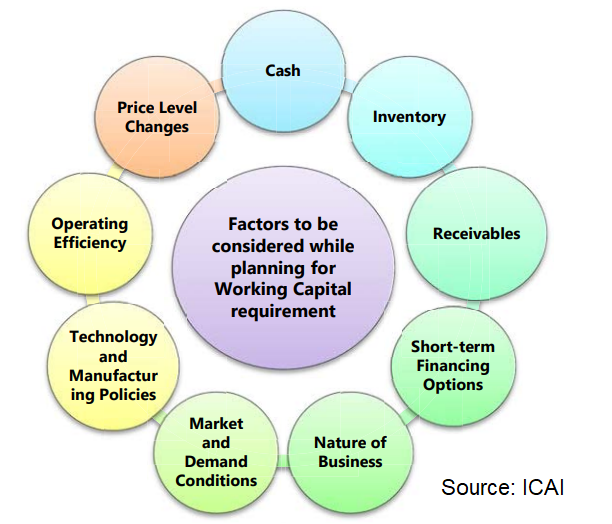
From the following, select the right option with reference to the working capital:
- Higher net working capital leads to higher liquidity and higher profitability
- According to hedging approach. current assets should be financed from long-term sources.
- There is an inverse relationship between the length of operating cycle of a firm and its working capital requirements.
- Trade-off plan, in general, is considered an appropriate financing strategy for working capital.
Solutions:
The correct answer is Trade-off plan, in general, is considered an appropriate financing strategy for working capital.
Key PointsWorking Capital = Current Assets – Current Liabilities
- Working capital affects both the liquidity as well as the profitability of a business. As the amount of working capital increases the liquidity of the business increases. However, since current assets offer low returns with the increase in working capital the profitability of the business falls.
- There are two types of working capital permanent and temporary working capital. The hedging approach suggests that the permanent working capital requirement should be financed through long-term funds, while temporary working capital should be financed through short-term funds.
- The length of the operating cycle refers to the number of days taken, right from procuring material to making collections against sales from customers. This can be measured in days or months. The length of the operating cycle is directly proportional to your working capital requirements. So, a longer period will attract a higher amount.
- In evaluating a firm’s net working capital position, an important consideration is a trade-off between profitability and risk. In other In words, the level of net working capital has a bearing on profitability and risk. The trade-off between these variables is that regardless of how the firm increases its profitability through the manipulation of working capital, the consequence is a corresponding increase in risk as measured by the level of Net Working Capital.
Important Points
Aggressive approach – The aggressive strategy is one of the approaches of working capital management wherein the company’s investments in working capital are kept at a minimum level, i.e., limited investment in current assets.
Conservative approach – Conservative strategy is one of the approaches of working capital management wherein the organization follows a strategy to invest a high amount of capital in current assets.
Moderate/Hedging or Matching approach – In this strategy, a balance between risk and return is maintained in order to benefit more by more effective use of the funds. This approach classifies the requirements of total working capital into permanent and temporary.
Additional Information
6. Question
Arrange the following steps in the process of GDR Issues:
(A) Registration with prescribed authority
(B) Appointment and vesting of shares with the custodian
(C) Approval of the regulatory authorities
(D) Listing of GDR
(E) GDR allotment
Choose the correct answer from the options given below:
- (C), (A), (B), (E), (D)
- (A), (B), (C), (D), (E)
- (A). (C), (B), (E), (D)
- (B), (A), (C), (D), (E)
Solutions:
The correct answer is (A). (C), (B), (E), (D)
Key Points
- A Global Depositary Receipt (GDR) is a sort of bank certificate issued in multiple nations for the purpose of purchasing shares of a global corporation.
- GDRs are convertible securities that incorporate shares in at least two markets, most frequently the U.S. and the Euromarkets. It can be characterized as a form or bank document that reflects shares of a worldwide corporation insofar as the shares are held by a foreign branch of an international banking institution.
- The shares themselves are traded like domestic shares, however, they can be purchased globally at a number of bank locations.
- GDRs are used by private markets to raise cash that is backed by dollars or euros. GDRs are referred to as EDRs if private markets attempt to purchase euros instead of dollars.
Important Points Process of GDR Issues:
- Registration with prescribed authority
- Approval of the regulatory authorities
- Appointment and vesting of shares with the custodian
- GDR allotment
- Listing of GDR
7. Question
A spot sale of a currency combined with a forward repurchase of the same currency is called which one of the following?
- Forex swap
- Swap rate
- Forward rate
- Spot rate
Solutions:
The correct answer is Forex swap
Key PointsSwap rate is the rate of the fixed leg of a swap as determined by its particular market and the parties involved. In an interest rate swap, it is the fixed interest rate exchanged for a benchmark rate such as LIBOR or the Fed Funds Rate plus or minus a spread. It is also the exchange rate associated with the fixed portion of a currency swap.
A foreign exchange swap (forex swap) is a simultaneous purchase and sale of identical amounts of one currency for another with two different value dates and may use foreign exchange derivatives. A foreign exchange swap has two legs – a spot transaction and a forward transaction – that are executed simultaneously for the same quantity, and therefore offset each other. Forward foreign exchange transactions occur if both companies have a currency the other needs.
A forward rate is a specified price agreed by all parties involved for the delivery of a good at a specific date in the future. The use of forward rates can be speculative if a buyer believes the future price of a good will be greater than the current forward rate. Alternatively, sellers use forward rates to mitigate the risk that the future price of a good materially decreases.
A spot rate is the real-time price quoted for the instant settlement of a contract. In commodities markets, the spot rate represents the current price for the purchase or sale of a commodity, security, or currency.
8. Question
Which are the major factors that lead to capital rationing?
(A) Imperfection of capital market.
(B) Reluctance to broaden the equity share-base for the fear of losing control.
(C) Inability to manage.
(D) Deficiencies in market information which might affect the availability of capital.
(E) Efficiency of Capital Market.
Choose the correct answer from the options given below:
- (A), (B), (D) only
- (C), (D), (E) only
- (A), (B), (C), (E) only
- (A), (B), (C), (D) only
Solutions:
The correct answer is (A), (B), (C), (D) only
Key Points
Rationing is a process of allocating limited resources over different demand centers in an optimal manner.
Capital rationing, therefore, means allocating a limited amount of capital over different projects available for investments in a way so as to maximize the overall net present value resulting from the entire investment.
Factors of Capital rationing:
- The increased cost of capital for higher capital/funding requirements.
- Higher debt in books of the company.
- Any internal management restriction.
- Lack of human resources or knowledge for undertaking all the projects.
Additional Information
Types of Rationing
- The first type of capital rationing is called hard capital rationing. This type of rationing happens if a company is having issues with raising excessive funds, either by means of debt or equity. The rationing happens from an external dependence in order to cut down on expenses and may result in a shortage of capital to raise enough money for projects in the future.
- The second kind of capital, rationing, is referred to as soft capital rationing. It is also called internal rationing. This happens because of the internal policies of an organization. A company that is financially conservative will have a high required return on the capital invested in taking up projects in the coming days, thereby imposing self-capital rationing.
9. Question
Banker sale of a mortgage portfolio by setting up a mortgage pass-through securities is an example of:
- Credit enhancement
- Unbundling
- Derivatives
- Securitization
Solutions:
The correct answer is Securitization
Key Points
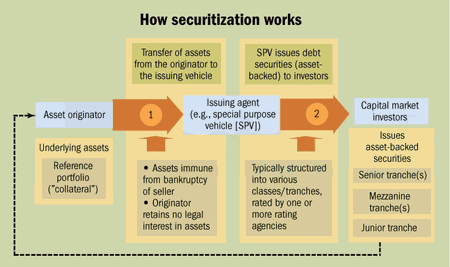
Securitization involves bundling loans and selling them to a special purpose vehicle (SPV), which then issues securities called pass-through certificates (PTCs) backed by the loan pool. For lenders of home loans, securitization would mean pooling home loans.
Additional Information
Unbundling occurs when a company disposes of business units, including assets, subsidiaries, etc. This process separates the revenues from the individual business units so that the company can focus on its core business.
A derivative is a security whose price depends on or is derived from one or more underlying assets. The derivative itself is a contract between two or more parties based on the asset or assets. Its value is determined by fluctuations in the underlying asset.
Credit enhancement is a strategy to improve the credit risk profile of a company, usually to obtain better terms for debt repayment. In the financial industry, credit enhancement can be used to reduce the risks for investors in certain structured financial products.
Discover more from WebComm.in
Subscribe to get the latest posts sent to your email.
