Unit I: Business Environment
Syllabus of this unit & where each question falls
- Business Environment – meaning, elements, economic environment & economic policies13 Q
- Economic Planning – meaning, objects, planning in India & M.P.10 Q
- Aspects of Business Environment – competition policy, consumer protection, environment protection5 Q2025 (2 Aug 2026) · Set AQ10
- Business Conditions – liberalization, privatization, globalization, MRTP Act 19699 Q
- Industrial Policy and NITI Aayog4 Q2024 (1 Jun 2025) · Set CQ52
AP Exam 2022 (Held 9 Jun 2024) — Set D
14 questions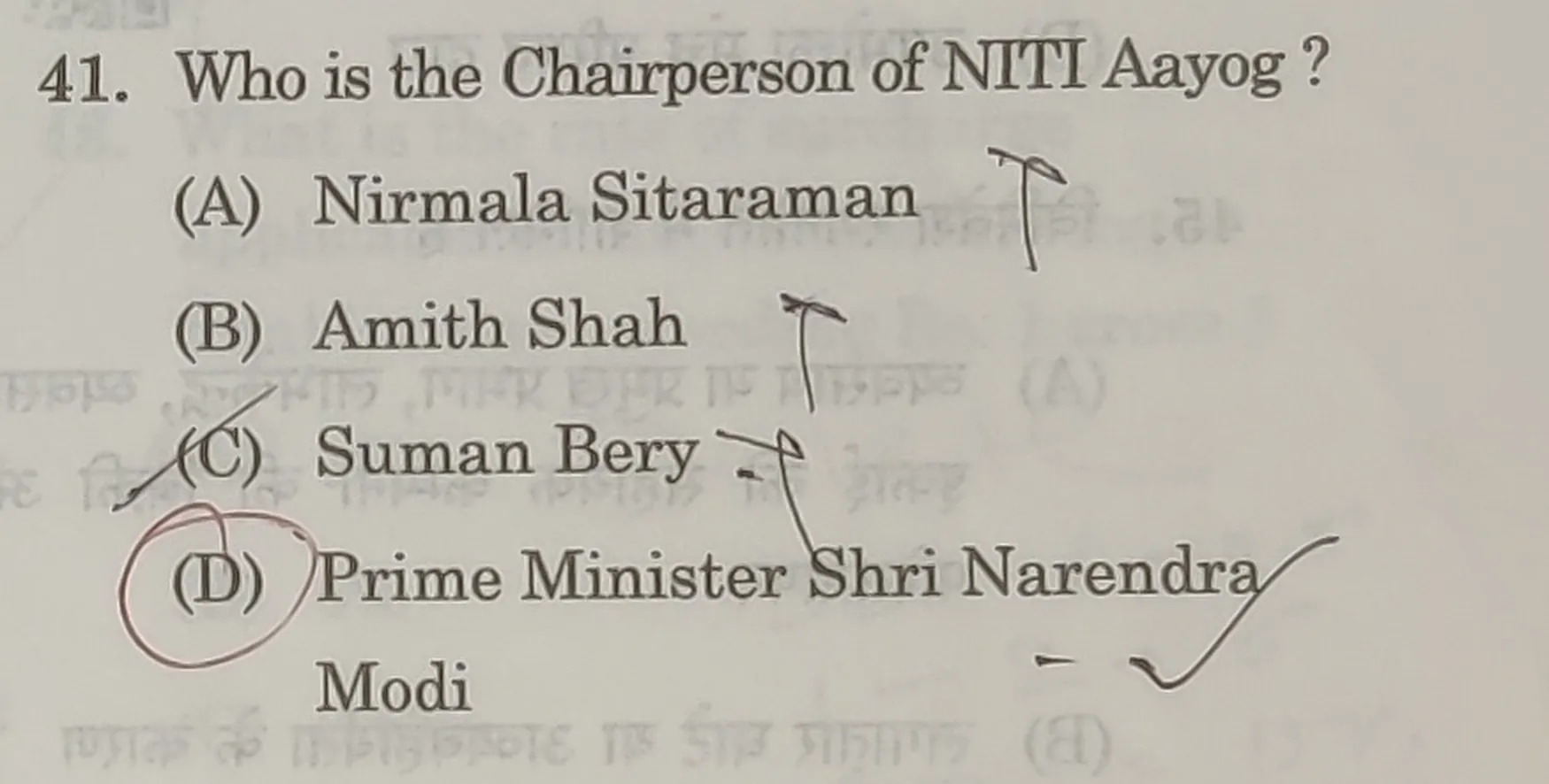
Why? explanation for all 4 options
- ✗A.Nirmala Sitharaman is the Union Finance Minister and an ex-officio NITI Aayog member, not its Chairperson.
- ✗B.Amit Shah is the Union Home Minister and an ex-officio NITI Aayog member, not its Chairperson.
- ✗C.Suman Bery holds the separate post of NITI Aayog Vice-Chairperson, not Chairperson.
- ✓D.Correct — under NITI Aayog's governing resolution, the Prime Minister of India is its ex-officio Chairperson.
Why? explanation for all 4 options
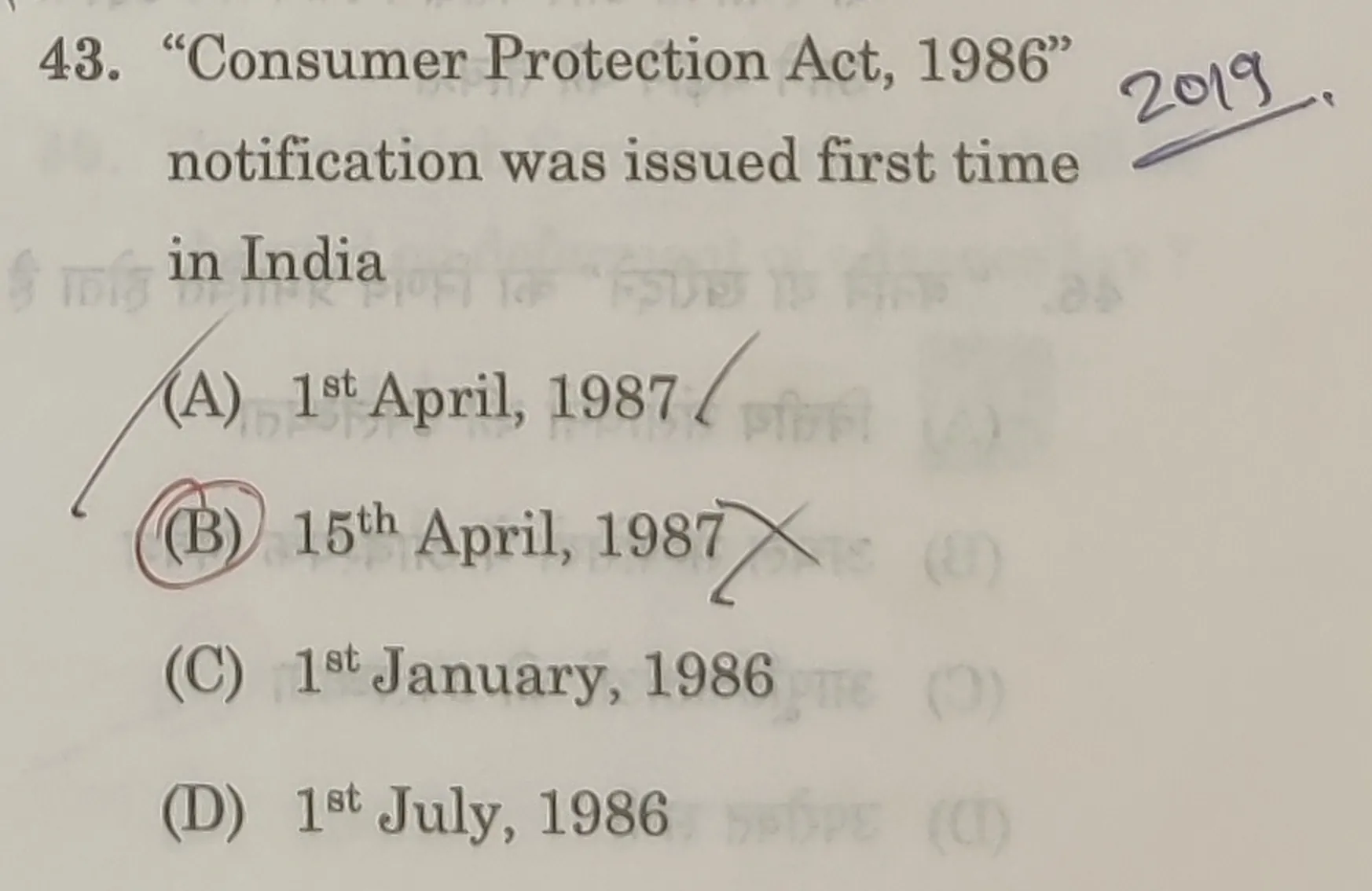
- ✗A.1 April 1987 is close but not the actual date — the Act was notified a fortnight later.
- ✓B.Correct — Chapters I, II and IV of the Consumer Protection Act, 1986 were brought into force on 15 April 1987 (Chapter III followed on 1 July 1987).
- ✗C.1 January 1986 is simply the Act's title year, not its date of enforcement; the Act was enacted later in 1986 and notified only in 1987.
- ✗D.1 July 1986 reuses the correct day/month of Chapter III's commencement but the wrong year — that chapter actually commenced on 1 July 1987.
Why? explanation for all 4 options
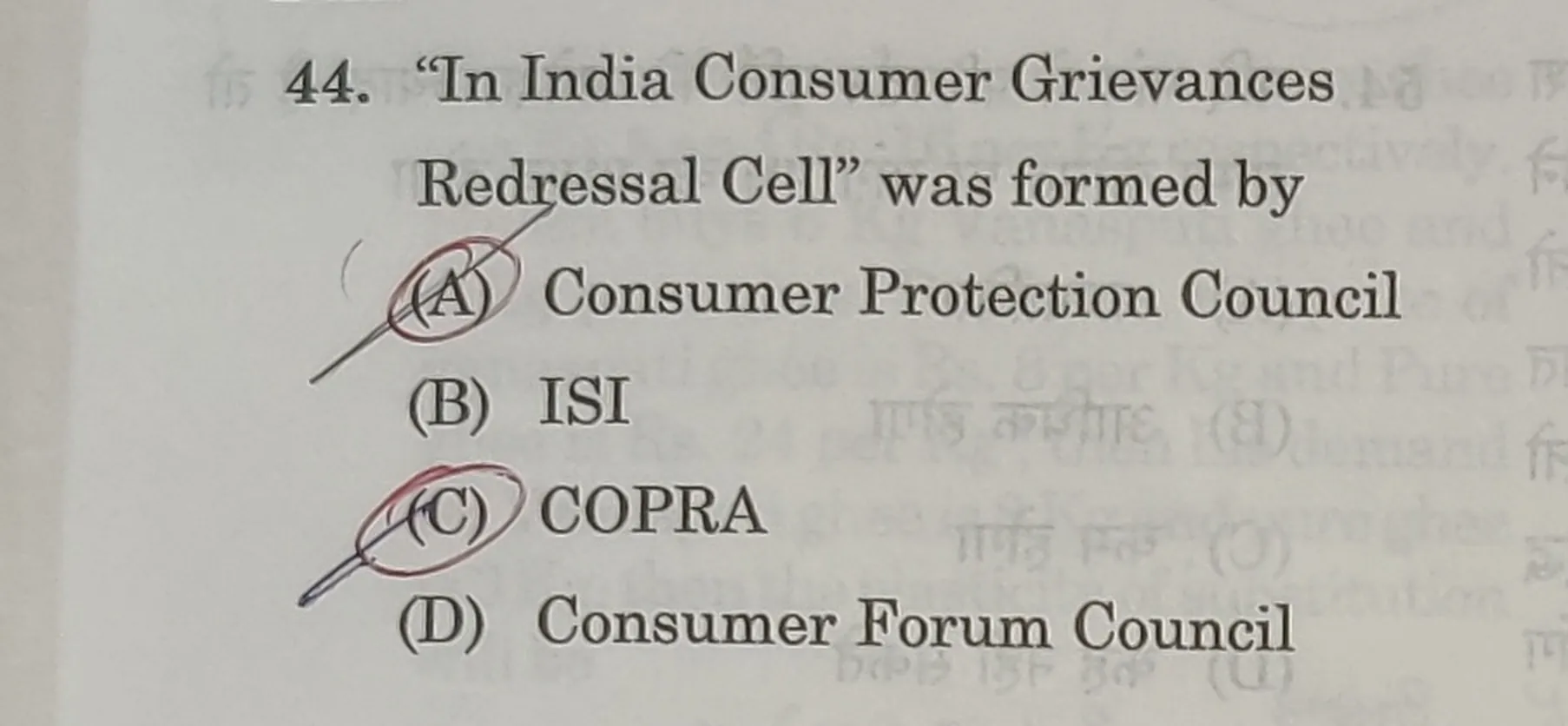
- ✓A.Correct — Consumer Protection Councils set up under the Act (Central/State/District) are part of the statutory grievance-redressal machinery.
- ✗B.ISI is the Bureau of Indian Standards' product-quality certification mark; it has no role in consumer grievance redressal.
- ✓C.Correct — COPRA (the Consumer Protection Act) is the parent legislation under which consumer grievance redressal bodies were established in India.
- ✗D."Consumer Forum Council" is not an officially recognised body — it wrongly fuses "Consumer Forum" (a redressal forum) with "Council" (an advisory body), which are distinct under the Act.
Why? explanation for all 4 options
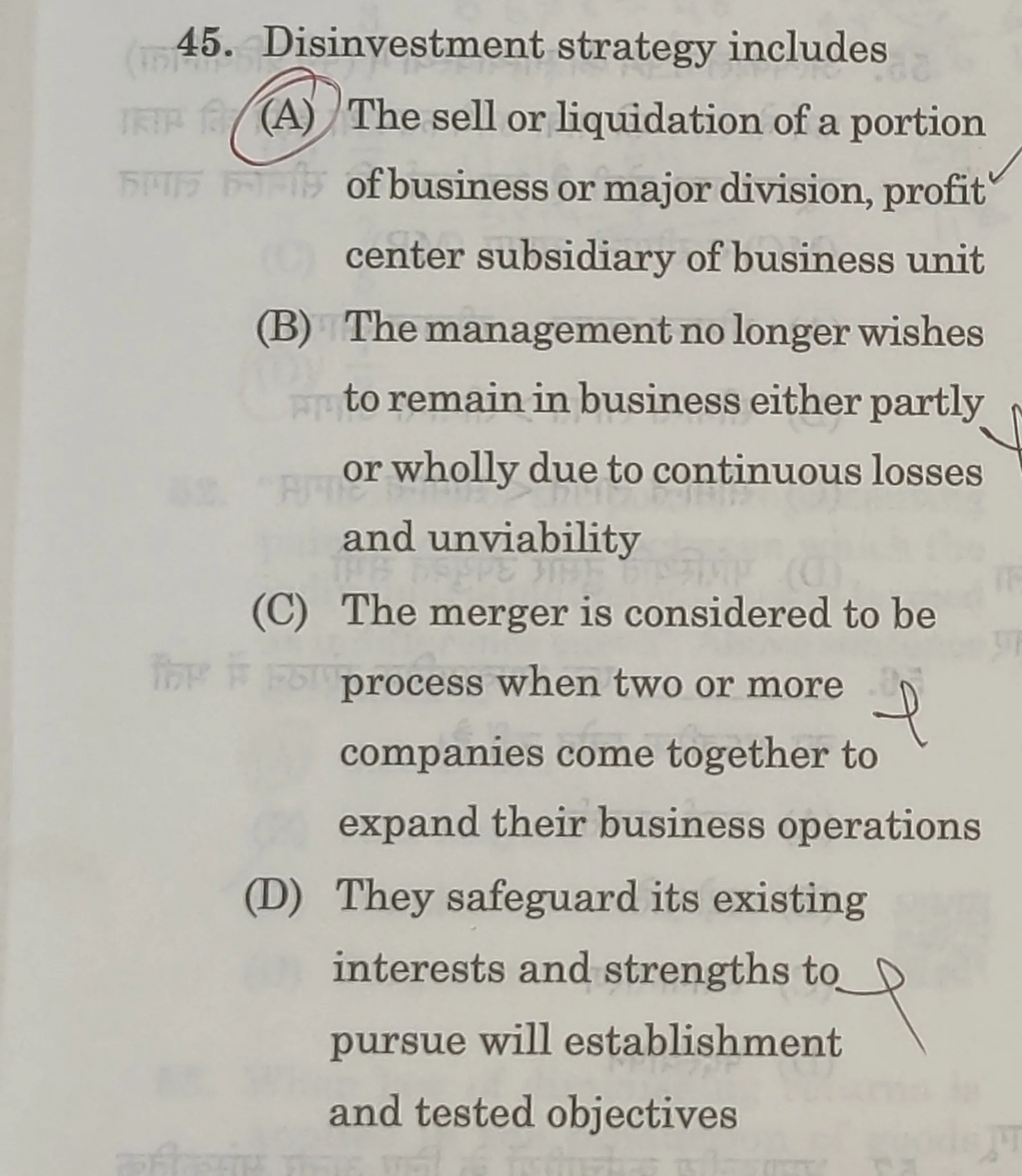
- ✓A.Correct — disinvestment is precisely the government selling or liquidating part of its stake in a business, division or profit-centre subsidiary.
- ✗B.This states a motive for wanting to exit a loss-making business, not the definition of the disinvestment strategy itself.
- ✗C.This describes a merger (companies combining to expand operations) — the opposite of divesting a stake.
- ✗D.This is a vague, non-standard phrase that does not correspond to any recognised meaning of disinvestment.
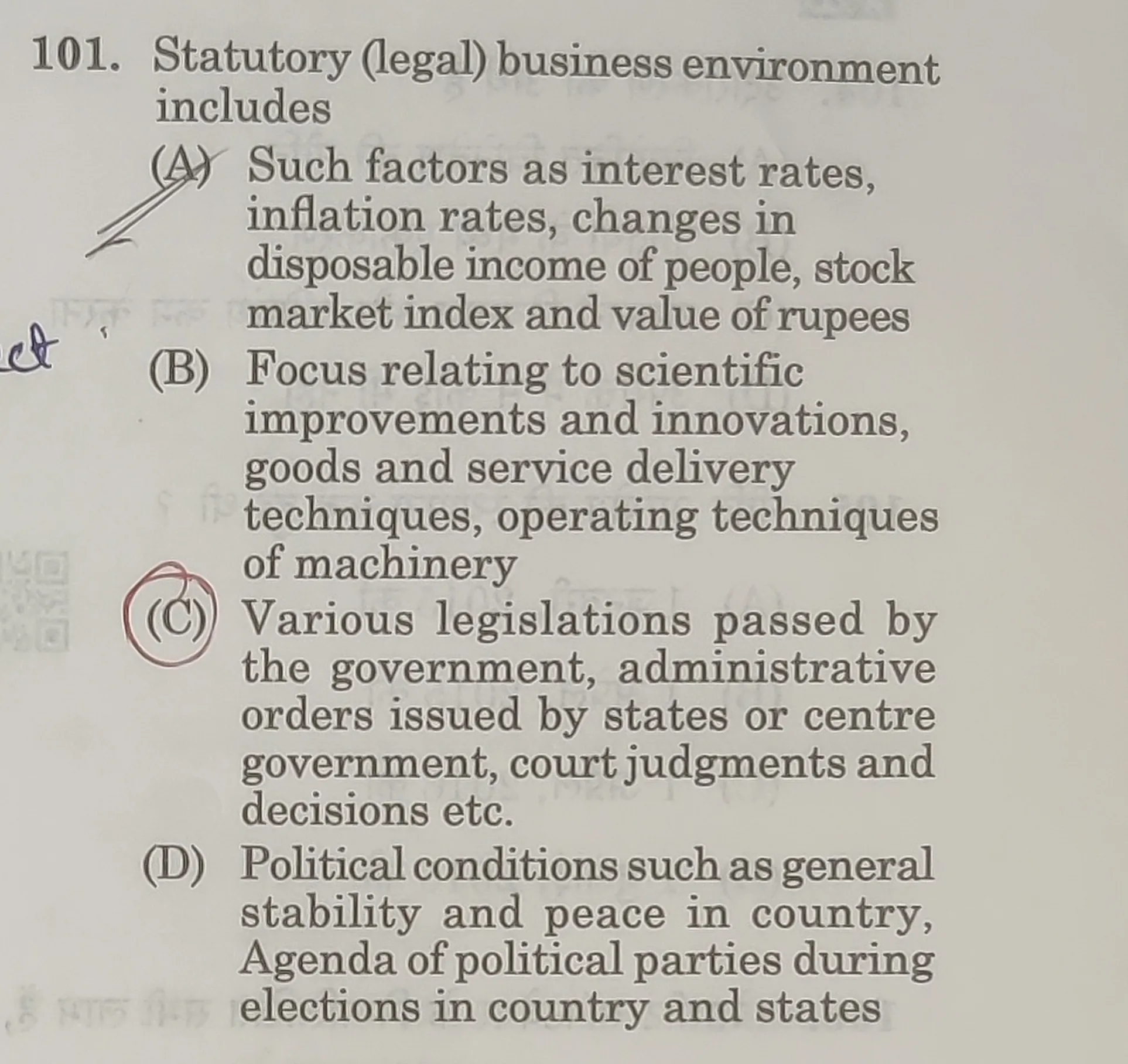
Why? explanation for all 4 options
- ✗A.This describes the Economic environment (interest rates, inflation, disposable income, stock indices), not the legal/statutory one.
- ✗B.This describes the Technological environment (innovations and delivery/operating techniques).
- ✓C.Correct — the statutory/legal environment consists of legislation, administrative orders and court judgments that a business must comply with.
- ✗D.This describes the Political environment (government stability, party agendas), a separate dimension from the legal environment.
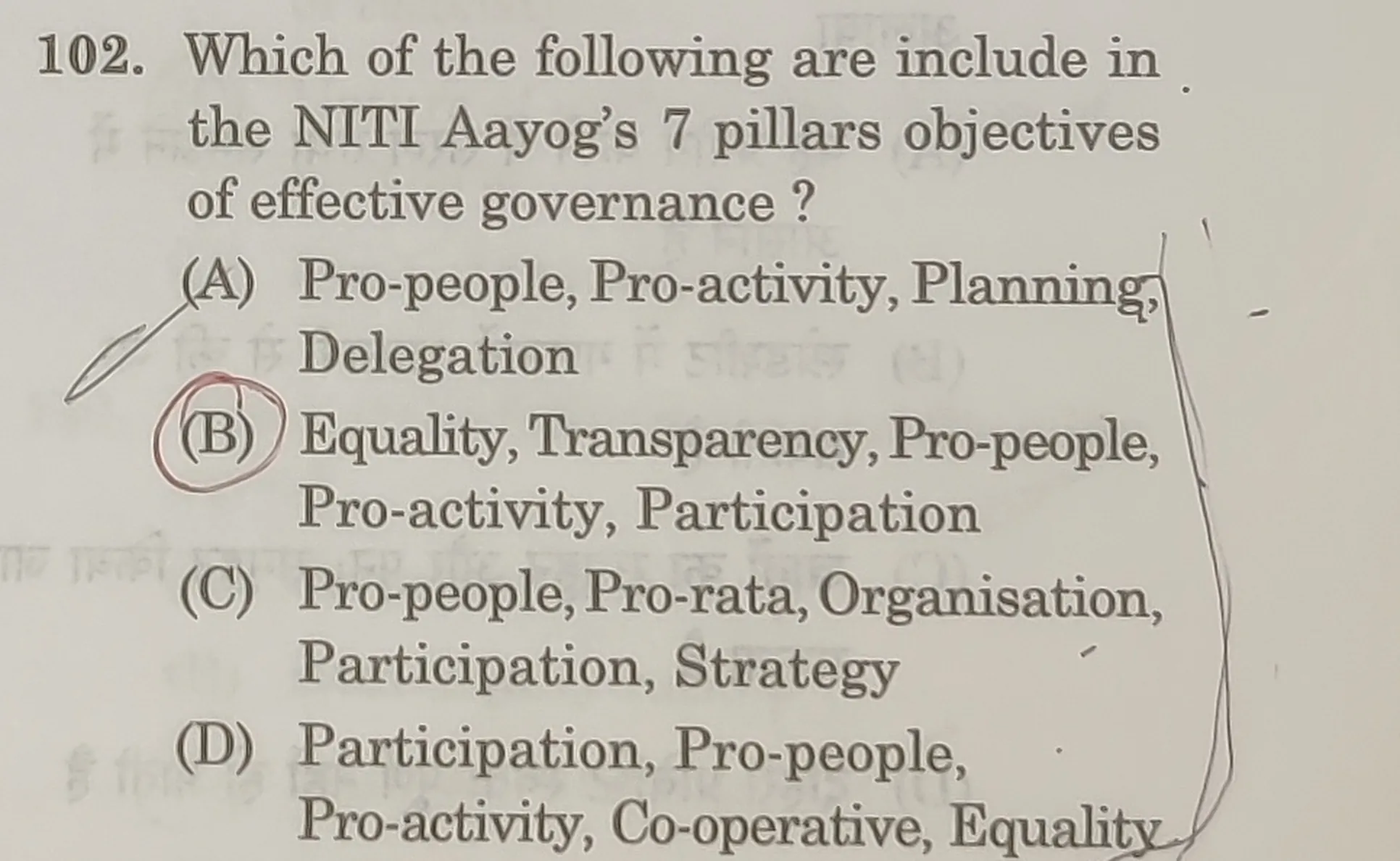
Why? explanation for all 4 options
- ✗A."Planning" and "Delegation" are not among NITI Aayog's seven pillars of effective governance.
- ✓B.Correct — Equality, Transparency, Pro-people and Pro-activity are four of NITI Aayog's seven pillars, and Participative(Participation) is a fifth — all five named here are genuine pillars.
- ✗C."Pro-rata", "Organisation" and "Strategy" are not among the seven pillars.
- ✗D."Co-operative" (echoing NITI Aayog's separate "cooperative federalism" mandate) is not itself one of the seven governance pillars.
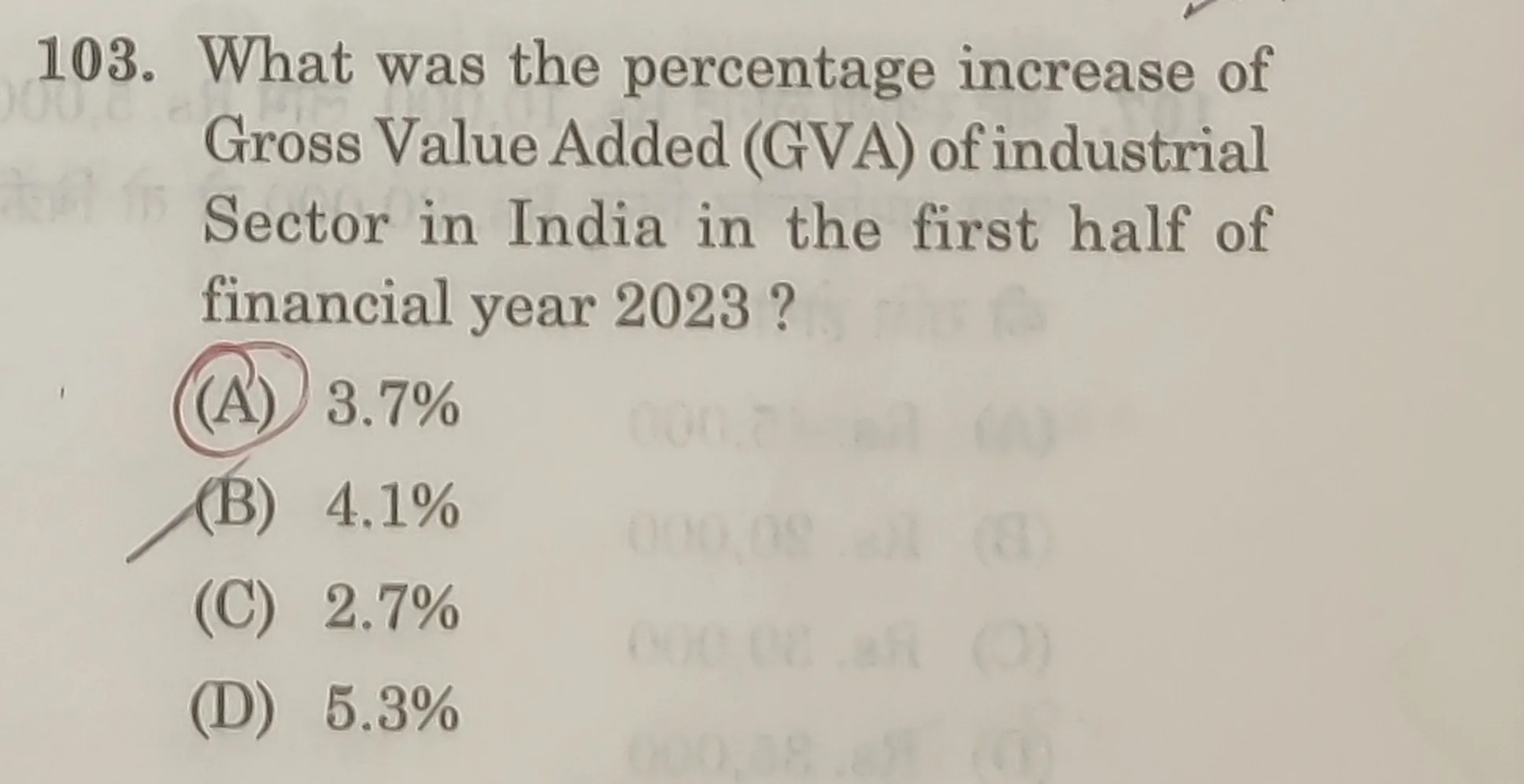
Why? explanation for all 4 options
- ✓A.Correct — the Government's Press Information Bureau reported industrial-sector GVA rose 3.7% in the first half of FY23.
- ✗B.4.1% overstates the actual first-half FY23 industrial GVA growth figure.
- ✗C.2.7% understates the actual first-half FY23 industrial GVA growth figure.
- ✗D.5.3% is well above the actual first-half FY23 industrial GVA growth figure.
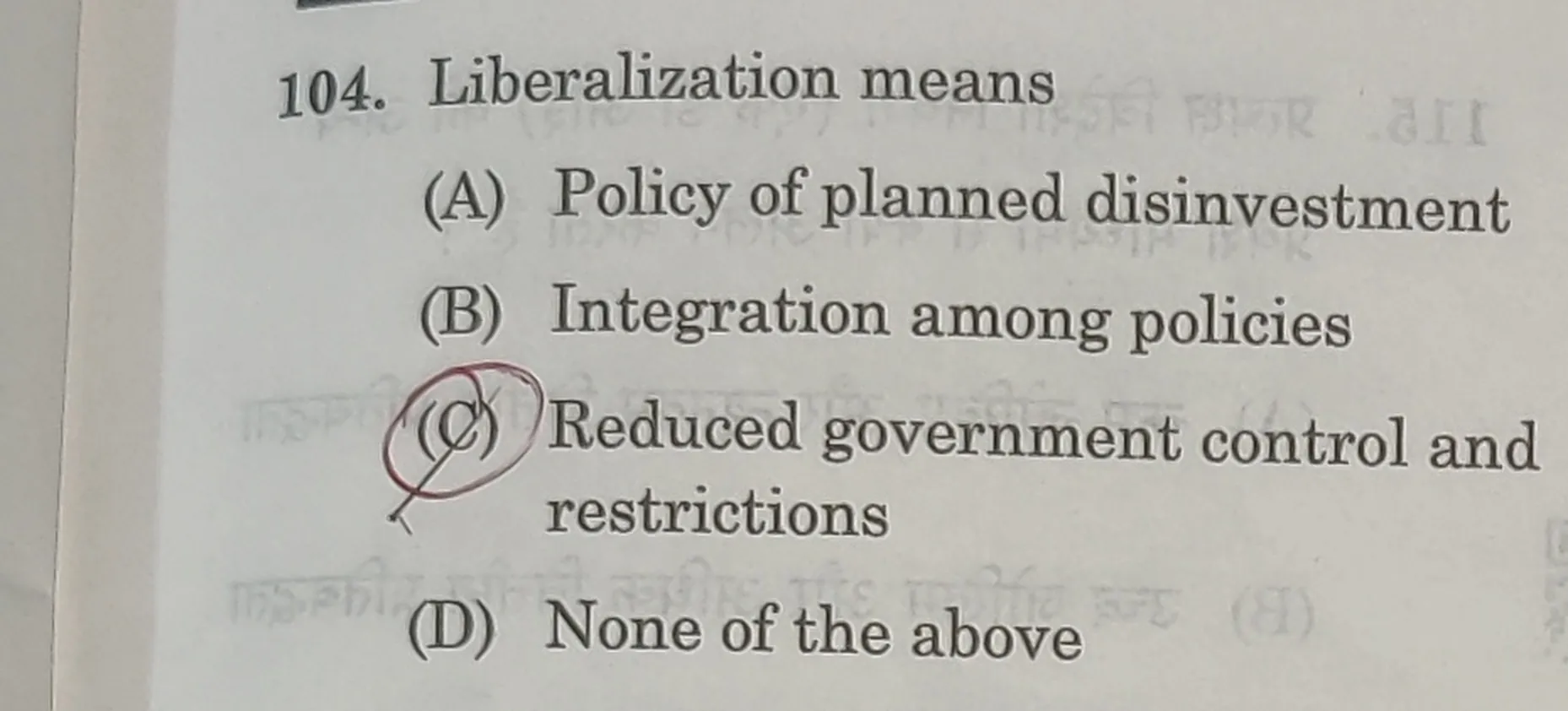
Why? explanation for all 4 options
- ✗A."Policy of planned disinvestment" describes disinvestment, not liberalisation.
- ✗B."Integration among policies" is not a recognised definition of liberalisation.
- ✓C.Correct — liberalisation means reducing government controls and restrictions on economic/business activity.
- ✗D.Liberalisation does have a specific, well-established meaning (option C), so "none of the above" is incorrect.
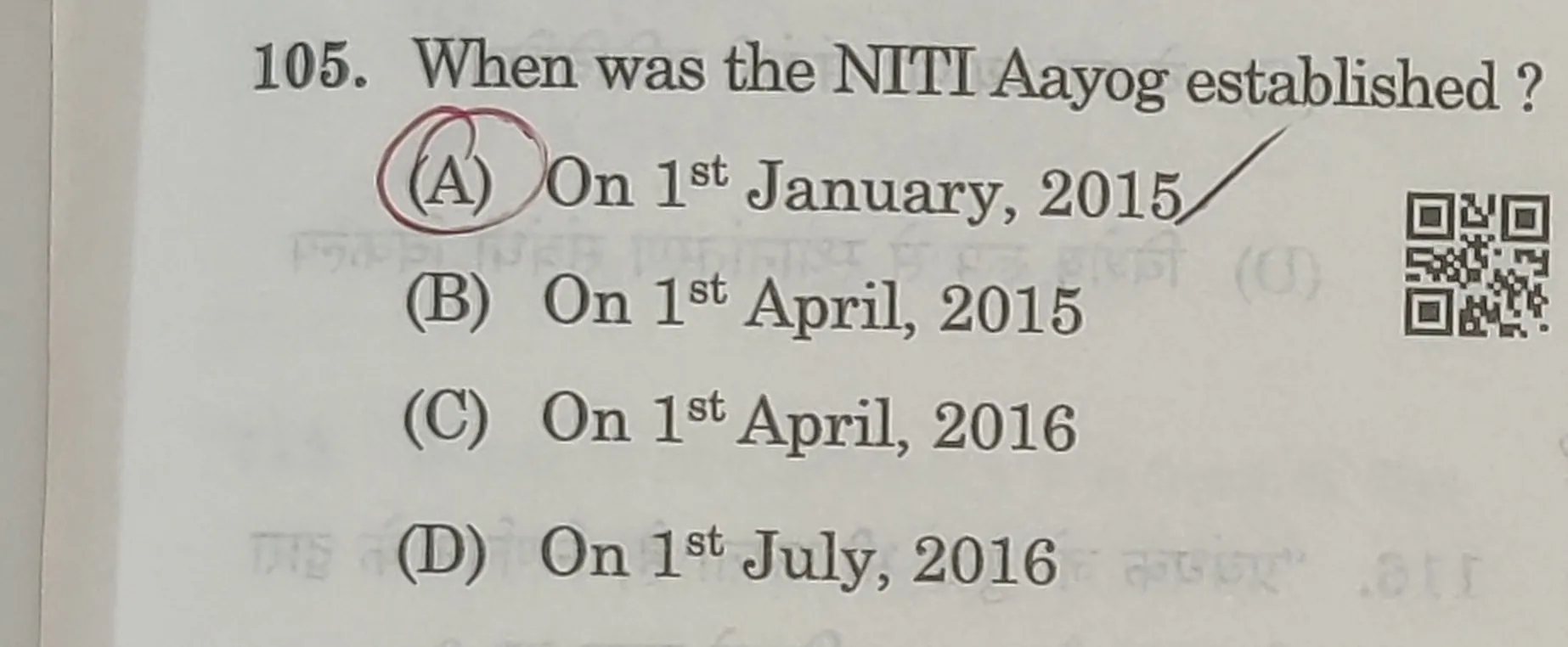
Why? explanation for all 4 options
- ✓A.Correct — NITI Aayog was established on 1 January 2015, replacing the Planning Commission.
- ✗B.1 April 2015 is not NITI Aayog's date of establishment, though its first full-year functioning began in that fiscal year.
- ✗C.1 April 2016 is a year after NITI Aayog's actual establishment.
- ✗D.1 July 2016 is well over a year after NITI Aayog's actual establishment.
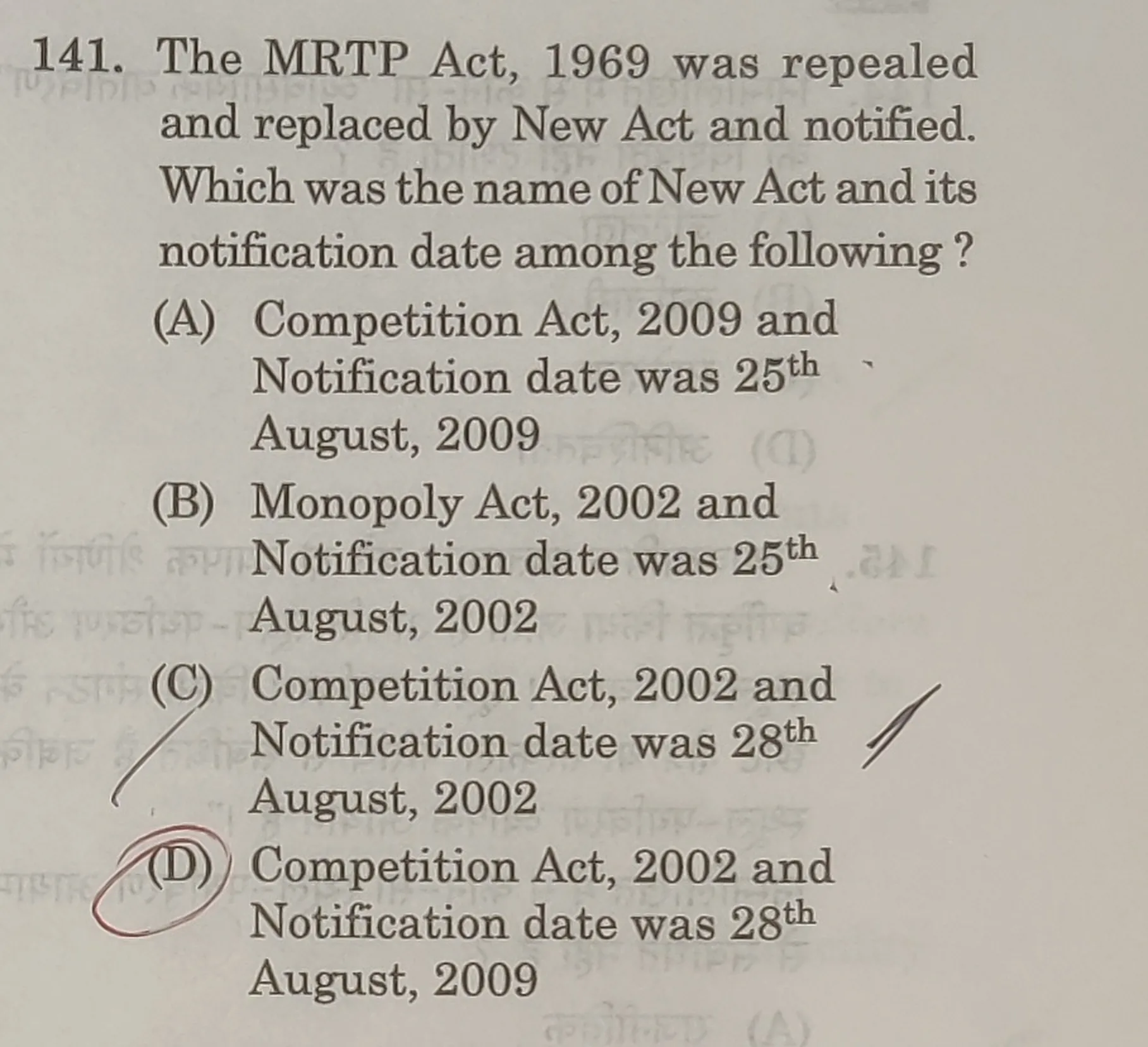
Why? explanation for all 4 options
- ✗A."Competition Act, 2009" is not the Act's name or year — the replacing law is the Competition Act, 2002.
- ✗B."Monopoly Act, 2002" is not the correct name — the Act that was repealed was the Monopolies and Restrictive Trade Practices (MRTP) Act, 1969, and its replacement is called the Competition Act.
- ✗C.The year and Act name are right, but the notification date given (28 August 2002) is wrong — the Act received assent only in January 2003 and its MRTP-repealing provisions were notified much later, in 2009.
- ✓D.Correct — the MRTP Act, 1969 was repealed and replaced by the Competition Act, 2002, with the repeal provisions notified on 28 August 2009 (effective 1 September 2009).
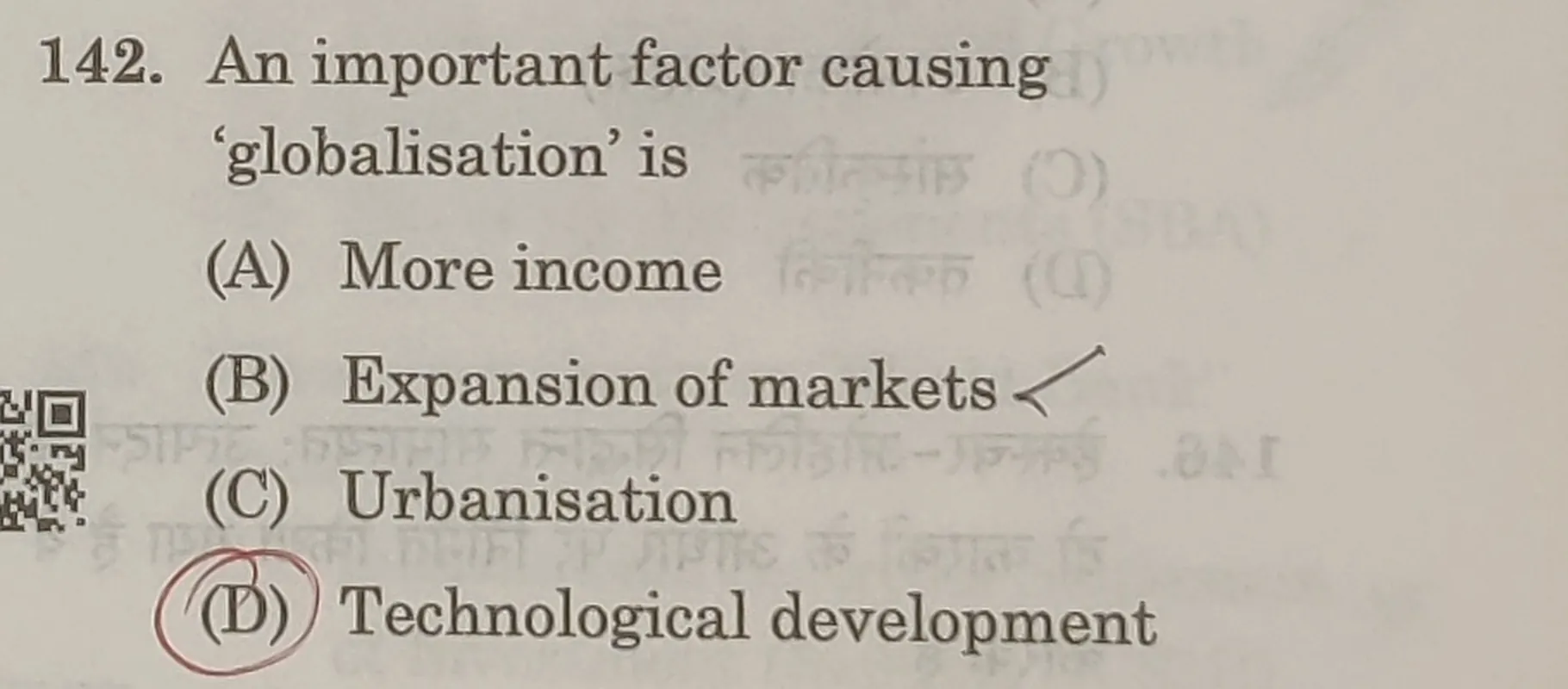
Why? explanation for all 4 options
- ✗A.Rising income is an effect/driver of growth generally, not the specific factor that defines globalisation.
- ✗B.Expansion of markets is a consequence of globalisation, not its underlying cause.
- ✗C.Urbanisation is a demographic/social trend, not a direct cause of globalisation.
- ✓D.Correct — technological development (transport, communication, IT) is the key enabling factor behind the increasing global integration of economies.
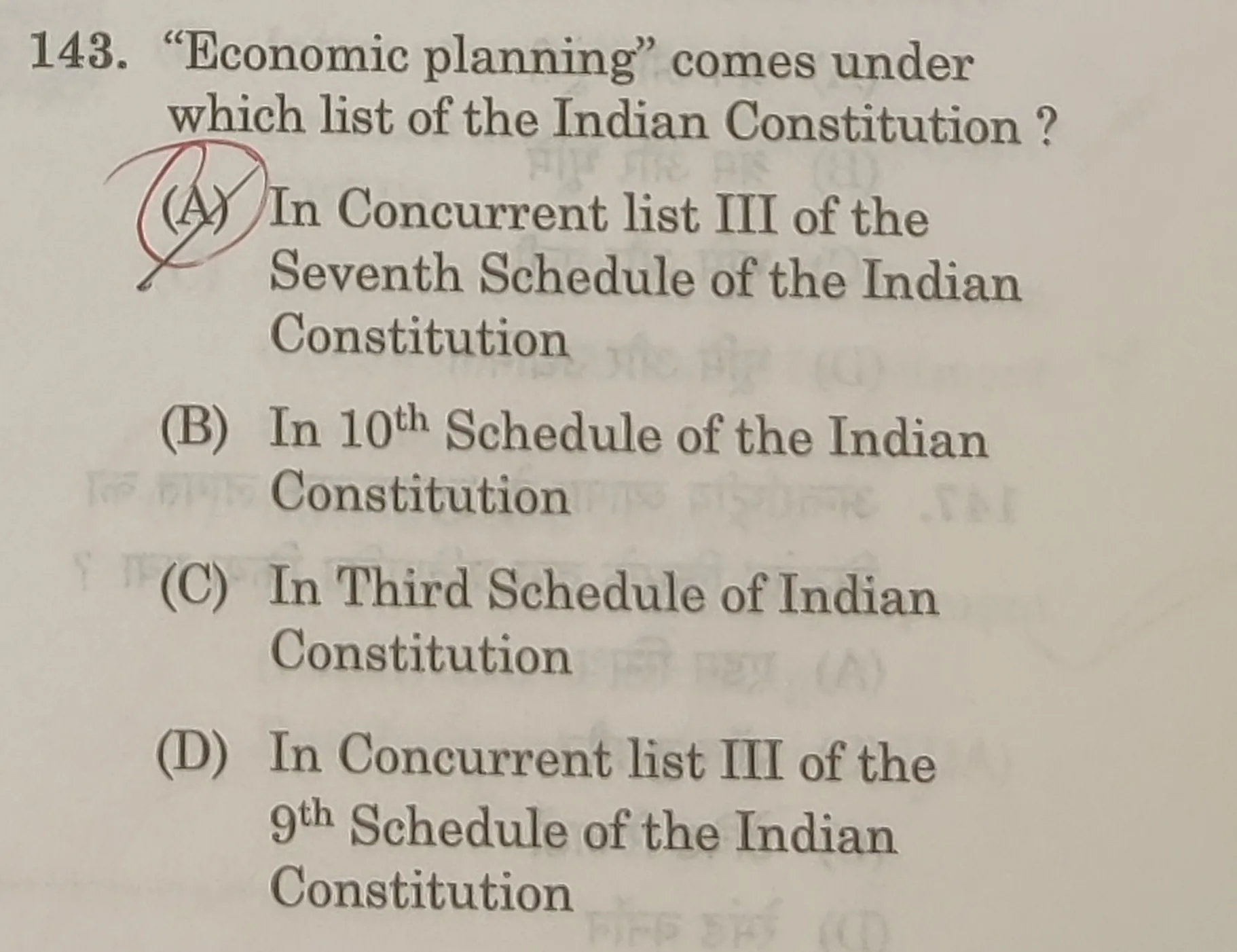
Why? explanation for all 4 options
- ✓A.Correct — "Economic and Social Planning" is Entry 20 of the Concurrent List (List III) in the Seventh Schedule of the Indian Constitution.
- ✗B.The Tenth Schedule deals with anti-defection law, not economic planning.
- ✗C.There is no "Third Schedule" provision for economic planning — the Third Schedule covers forms of oaths/affirmations.
- ✗D.There is no Ninth Schedule concurrent list for planning — the Ninth Schedule separately lists laws protected from judicial review.
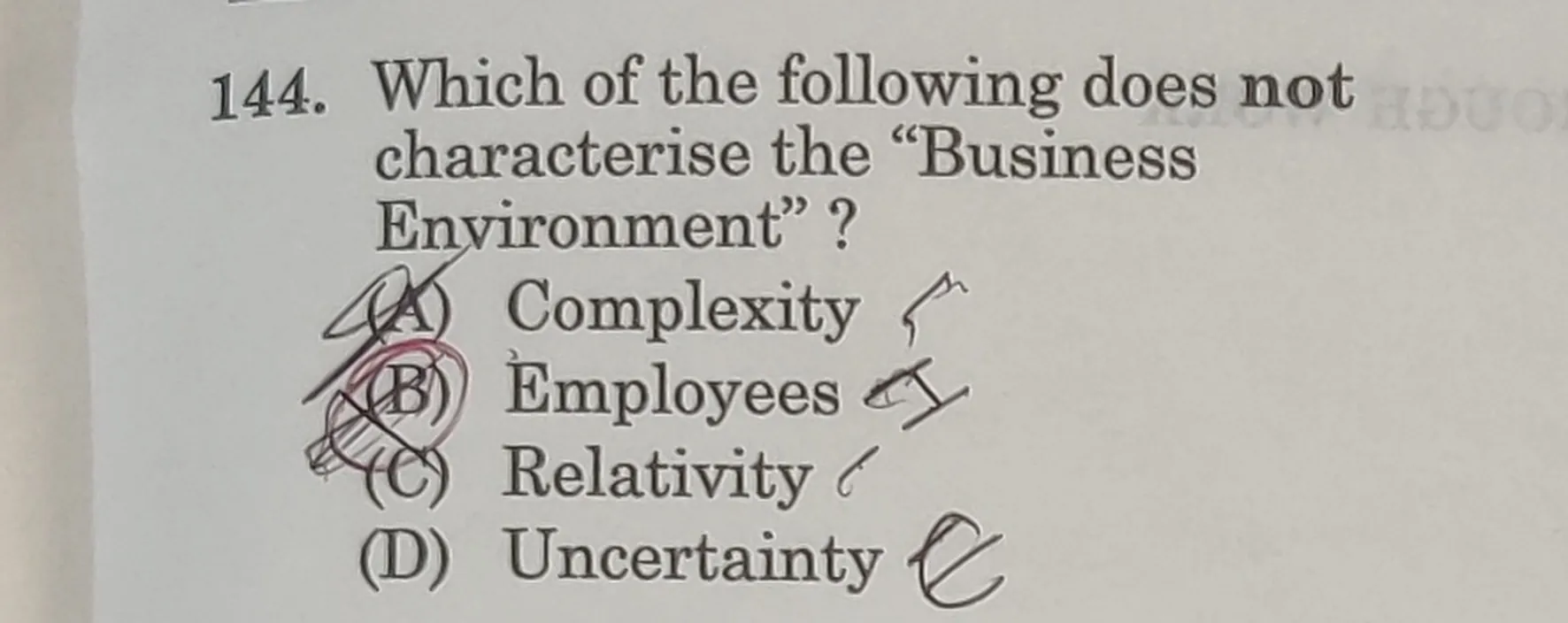
Why? explanation for all 4 options
- ✗A.Complexity is a recognised characteristic of the business environment (it is made up of many interrelated factors).
- ✓B.Correct — "Employees" are an internal organisational resource, not a defining feature/characteristic of the business environment itself.
- ✗C.Relativity is a recognised characteristic — the business environment differs by place and time.
- ✗D.Uncertainty is a recognised characteristic — the business environment is difficult to predict accurately.
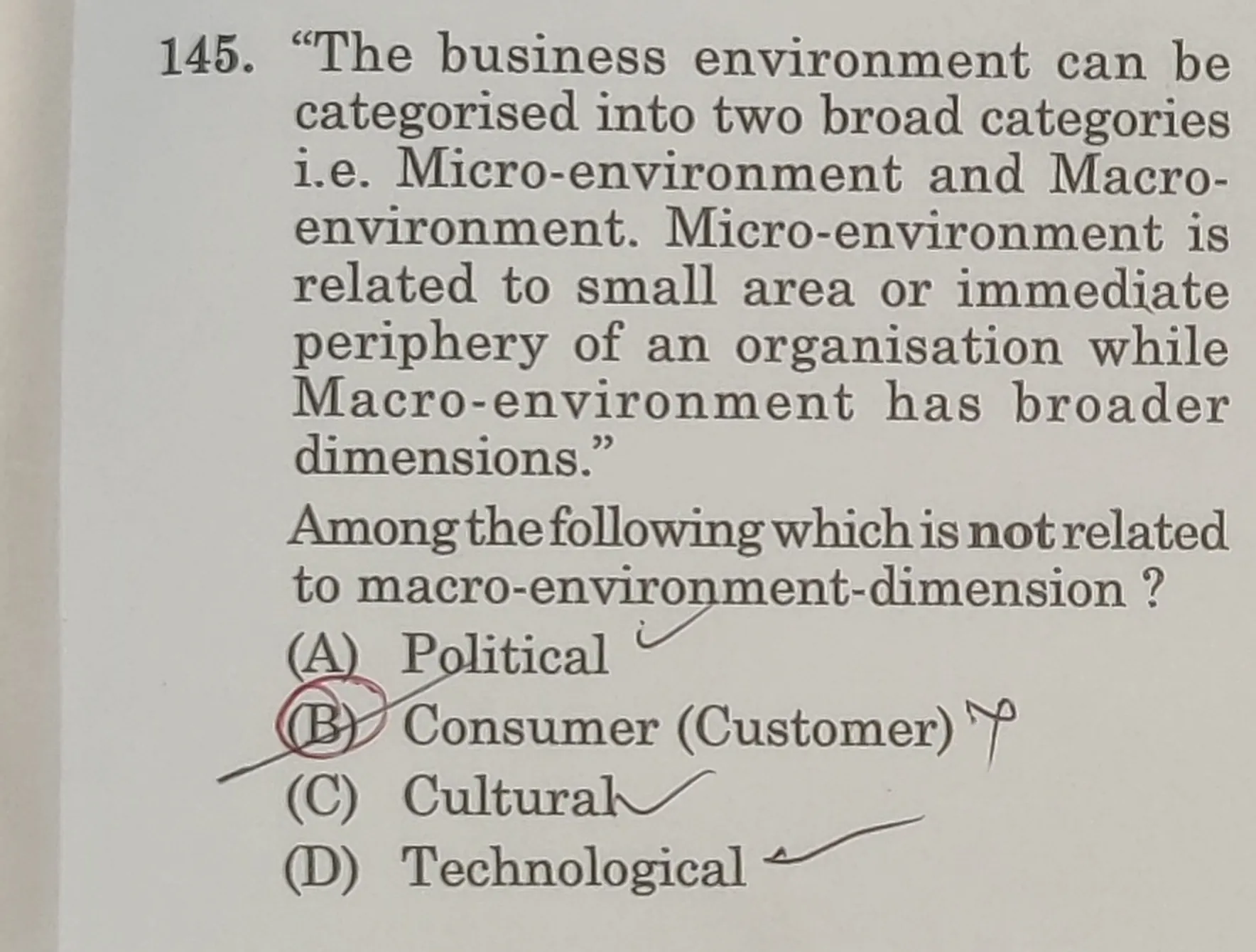
Why? explanation for all 4 options
- ✗A.Political conditions are a recognised macro-environment (external, broad) dimension.
- ✓B.Correct — an individual consumer/customer is part of a firm's immediate, micro-environment, not the broader macro-environment.
- ✗C.Cultural factors are a recognised macro-environment dimension.
- ✗D.Technological factors are a recognised macro-environment dimension.
AP Exam 2024 (Held 1 Jun 2025) — Set C
15 questions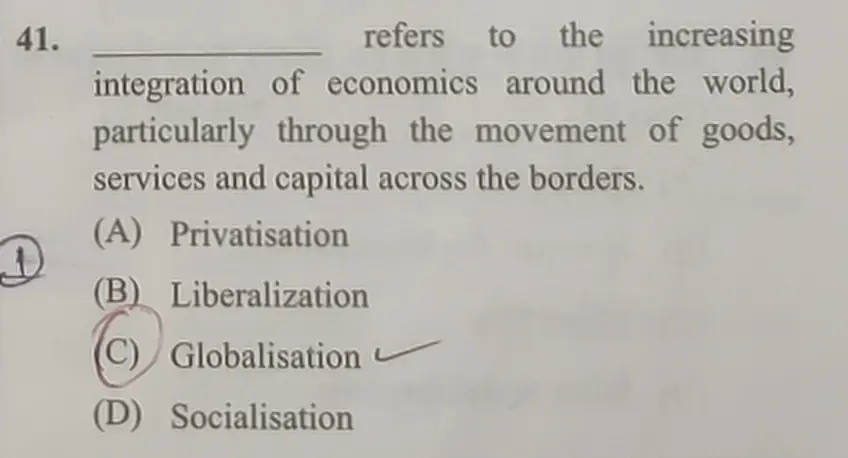
Why? explanation for all 4 options
- ✗A.Privatisation means transferring ownership/control from government to private hands — a different process from global economic integration.
- ✗B.Liberalisation means reducing government controls and restrictions — it is a domestic policy shift, not global integration itself.
- ✓C.Correct — globalisation specifically refers to the increasing integration of economies worldwide through cross-border movement of goods, services and capital.
- ✗D.Socialisation is not a recognised business-environment term for global economic integration.
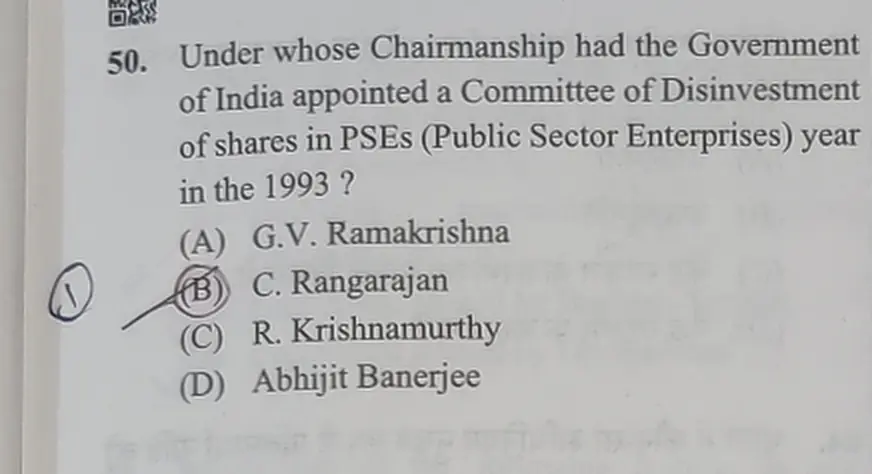
Why? explanation for all 4 options
- ✗A.G.V. Ramakrishna later headed the Disinvestment Commission (from 1996), not the 1993 Committee on Disinvestment of Shares in PSEs.
- ✓B.Correct — the 1993 Committee on Disinvestment of Shares in Public Sector Enterprises was chaired by C. Rangarajan (then a member of the Economic Advisory Council).
- ✗C.R. Krishnamurthy did not chair this 1993 committee.
- ✗D.Abhijit Banerjee did not chair this 1993 committee; he is a contemporary economist unrelated to the 1990s disinvestment committees.
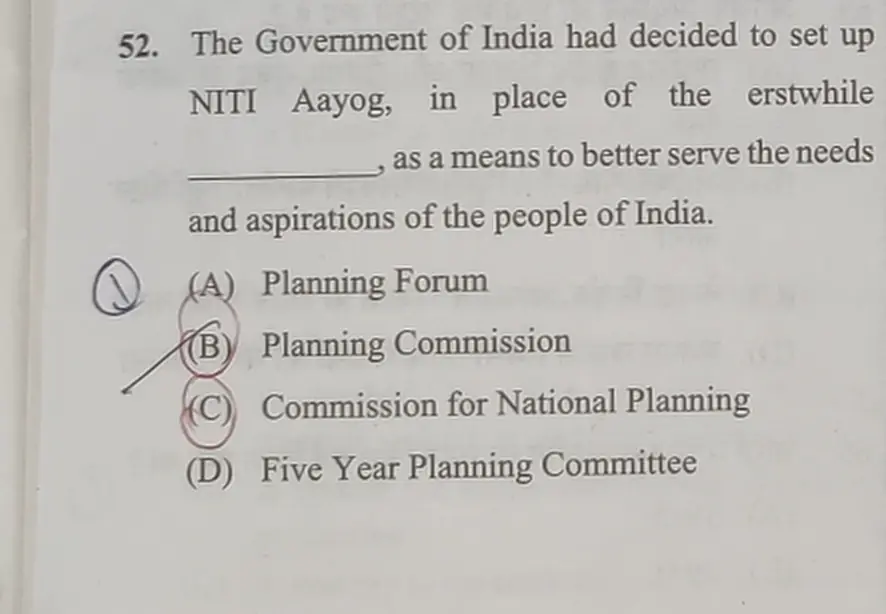
Why? explanation for all 4 options
- ✗A."Planning Forum" is not the body NITI Aayog replaced.
- ✓B.Correct — NITI Aayog replaced the Planning Commission (established 1950) in January 2015.
- ✓C.Correct (also accepted) — the official key accepts this as an alternate description of the planning body NITI Aayog superseded.
- ✗D.There was no body formally named the "Five Year Planning Committee" that NITI Aayog replaced — five-year plans were prepared by the Planning Commission.
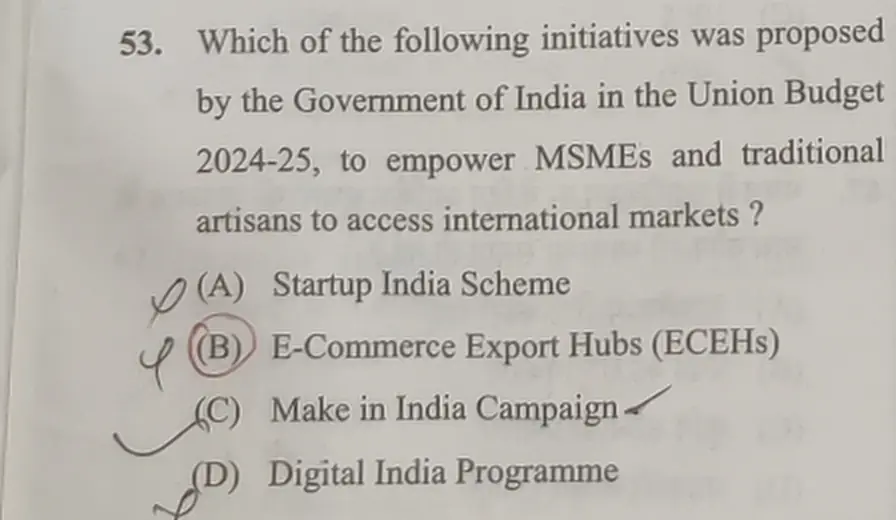
Why? explanation for all 4 options
- ✗A.The Startup India Scheme (launched 2016) supports new-age startups broadly, and was not a Budget 2024-25 MSME-export initiative.
- ✓B.Correct — Union Budget 2024-25 proposed E-Commerce Export Hubs (ECEHs), under a public-private-partnership model, to help MSMEs and artisans sell their products internationally.
- ✗C."Make in India" (launched 2014) promotes domestic manufacturing generally; it was not the specific MSME e-commerce export proposal in Budget 2024-25.
- ✗D.Digital India (launched 2015) is a broad digital-infrastructure programme, not the Budget 2024-25 MSME export-hub proposal.
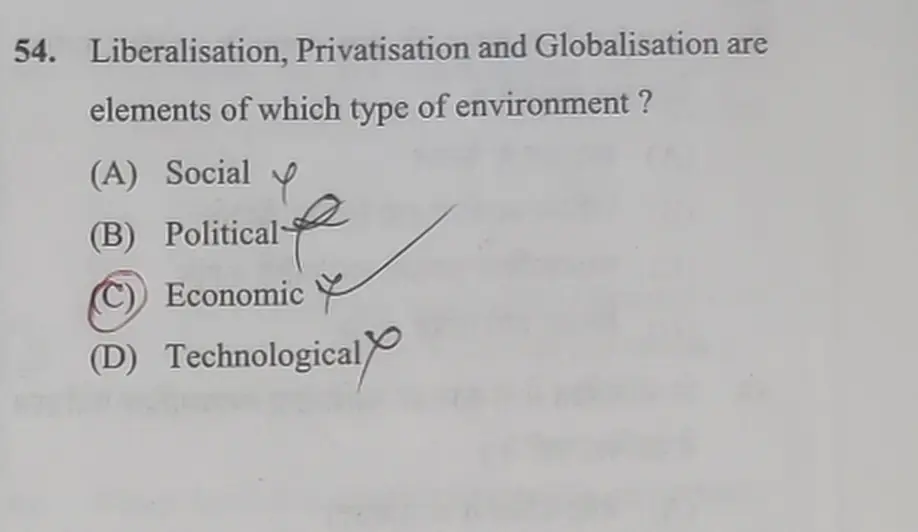
Why? explanation for all 4 options
- ✗A.These three reforms are not primarily about society/social structure, so "Social" is not the best fit.
- ✗B.These reforms are not primarily about the machinery of government/political institutions, so "Political" is not the best fit.
- ✓C.Correct — Liberalisation, Privatisation and Globalisation (the LPG reforms of 1991) are elements of India's Economic environment/policy.
- ✗D.These reforms are economic policy changes, not technological developments.
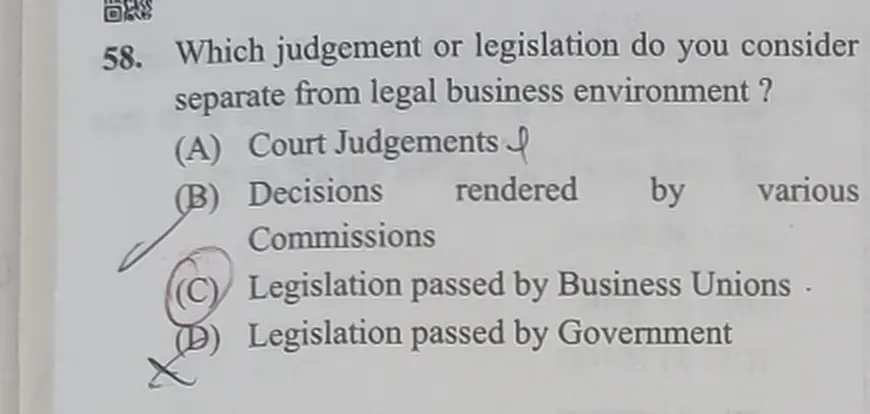
Why? explanation for all 4 options
- ✗A.Court judgements interpreting the law are themselves part of the legal business environment, not separate from it.
- ✗B.Decisions of statutory Commissions (e.g. SEBI, CCI orders) are part of the legal/regulatory environment businesses must follow.
- ✓C.Correct — internal rules passed by a private Business Union/association are not government law, so they fall outside the formal "legal business environment".
- ✗D.Legislation passed by the Government is, by definition, part of the legal business environment.
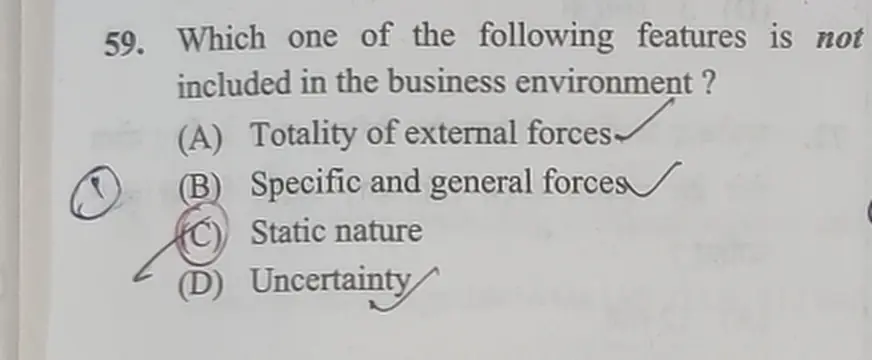
Why? explanation for all 4 options
- ✗A."Totality of external forces" is a recognised feature of the business environment (it comprises everything outside the firm).
- ✗B.The distinction between "specific" (micro) and "general" (macro) forces is a recognised classification within business environment study.
- ✓C.Correct — the business environment is dynamic (constantly changing), not static, so "static nature" is not a true feature.
- ✗D.Uncertainty (unpredictability of environmental change) is a recognised feature of the business environment.
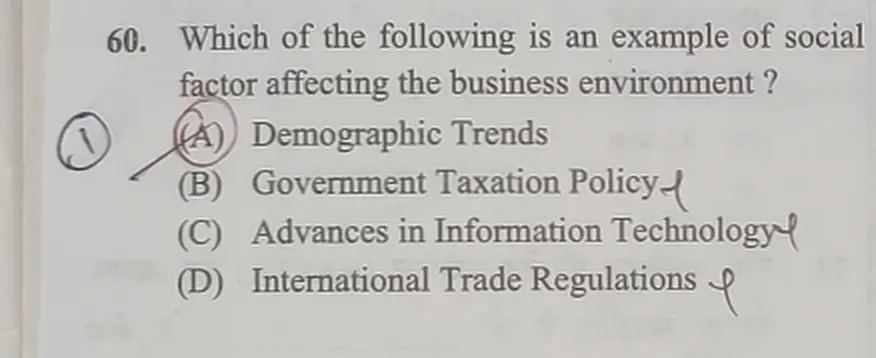
Why? explanation for all 4 options
- ✓A.Correct — demographic trends (population size, age structure, literacy, etc.) are a classic example of a social factor affecting business.
- ✗B.Government taxation policy is an economic/legal factor, not a social one.
- ✗C.Advances in information technology are a technological factor, not a social one.
- ✗D.International trade regulations are a legal/economic (and international) factor, not a social one.
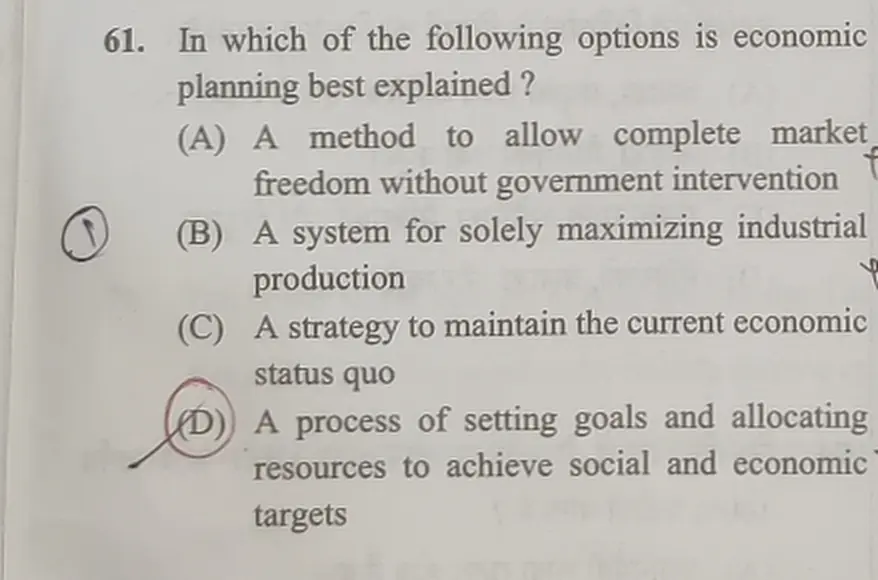
Why? explanation for all 4 options
- ✗A.Complete market freedom without any government intervention describes laissez-faire capitalism, not planning.
- ✗B.Solely maximising industrial production ignores social/welfare objectives that planning also pursues — too narrow a definition.
- ✗C.Merely maintaining the status quo is the opposite of planning, which deliberately directs change.
- ✓D.Correct — economic planning is best defined as the deliberate process of setting goals and allocating resources to achieve social and economic targets.
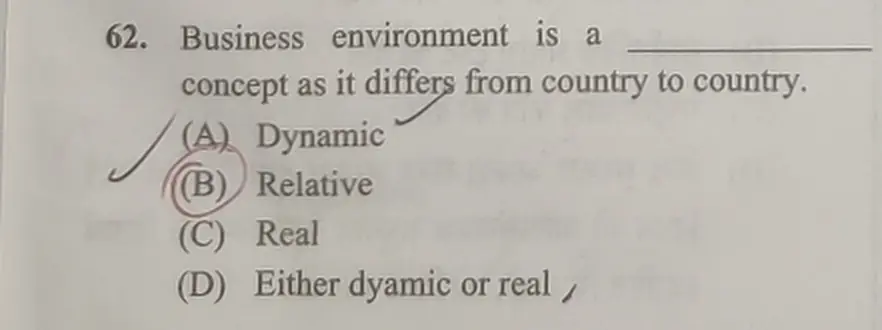
Why? explanation for all 4 options
- ✗A."Dynamic" describes that the environment keeps changing over time — a different property from varying "country to country".
- ✓B.Correct — "Relative" captures that the business environment differs across countries/regions, which is exactly what the question describes.
- ✗C."Real" is not the term used for this country-to-country variation property.
- ✗D."Either dynamic or real" is not a recognised single characteristic and doesn't name the country-to-country variation described.
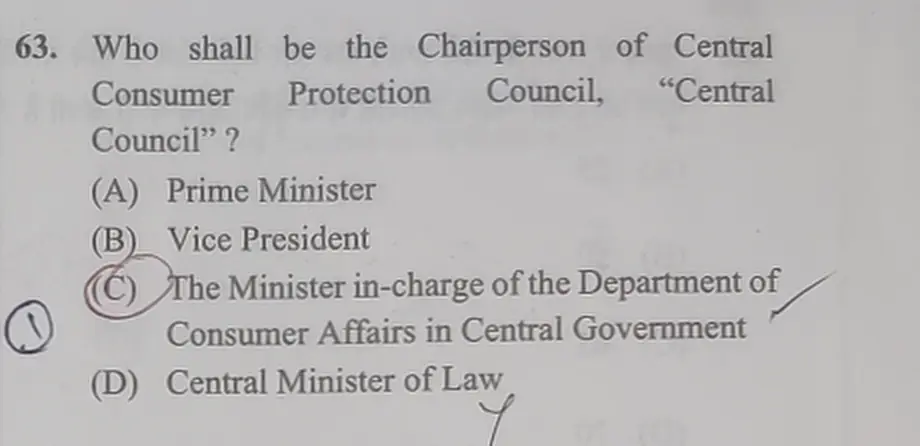
Why? explanation for all 4 options
- ✗A.The Prime Minister does not chair the Central Consumer Protection Council under the 2019 Act.
- ✗B.The Vice President does not chair the Central Consumer Protection Council.
- ✓C.Correct — under the Consumer Protection Act, the Minister-in-charge of the Department of Consumer Affairs in the Central Government chairs the Central Consumer Protection Council.
- ✗D.There is no "Central Minister of Law" post that chairs this Council — that is a different ministry altogether.
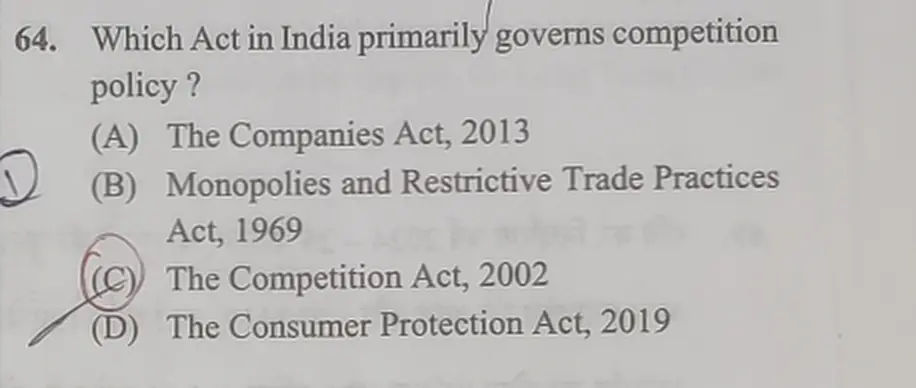
Why? explanation for all 4 options
- ✗A.The Companies Act, 2013 governs company incorporation and corporate governance, not competition policy.
- ✗B.The MRTP Act, 1969 was India's earlier competition-related law but has been repealed and replaced — it no longer primarily governs competition policy.
- ✓C.Correct — the Competition Act, 2002 (which replaced the MRTP Act) is the law that currently governs competition policy in India.
- ✗D.The Consumer Protection Act, 2019 protects consumer rights; it is a separate law from competition policy.
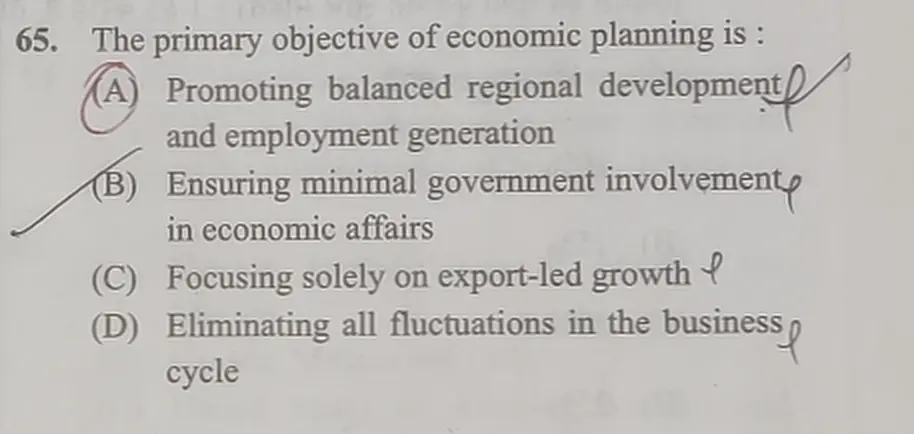
Why? explanation for all 4 options
- ✓A.Correct — economic planning's primary objective is promoting balanced regional development and generating employment.
- ✗B.Minimal government involvement describes laissez-faire economics, the opposite of planning's active, directed approach.
- ✗C.Focusing solely on export-led growth is far too narrow to be the primary objective of economic planning.
- ✗D.Eliminating all business-cycle fluctuations is an unrealistic/overstated claim, not the stated primary objective of planning.
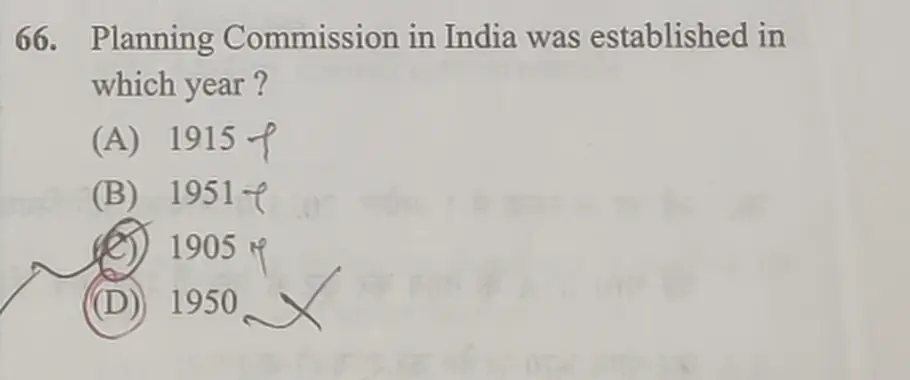
Why? explanation for all 4 options
- ✗A.1915 predates Indian economic planning institutions entirely.
- ✗B.1951 is when India's First Five Year Plan began, a year after the Commission itself was set up.
- ✗C.1905 is unrelated to the Planning Commission's history.
- ✓D.Correct — the Planning Commission of India was established on 15 March 1950.
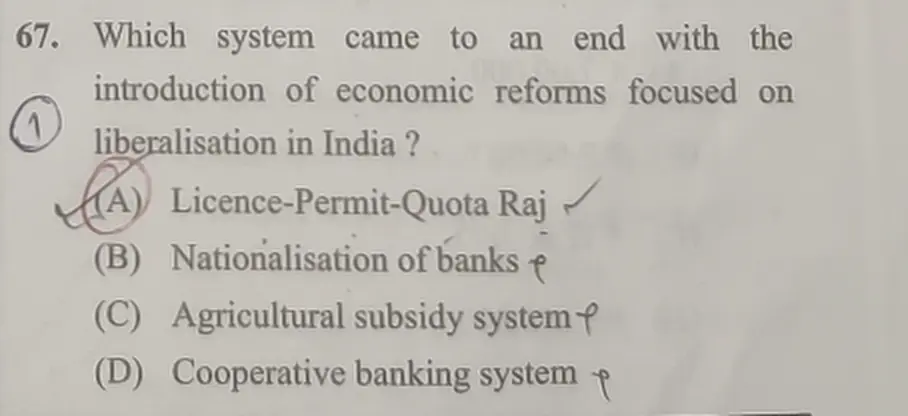
Why? explanation for all 4 options
- ✓A.Correct — the License-Permit-Quota Raj (the system of licences/permits controlling industry) ended with the 1991 liberalisation reforms.
- ✗B.Bank nationalisation (1969, 1980) was a separate historical event, not something ended by the 1991 reforms.
- ✗C.Agricultural subsidies were not ended by the 1991 industrial/trade liberalisation reforms — they have continued since.
- ✗D.Cooperative banking was not abolished by the 1991 reforms — cooperative banks still operate in India today.
AP Exam 2025 (Held 2 Aug 2026) — Set A
12 questions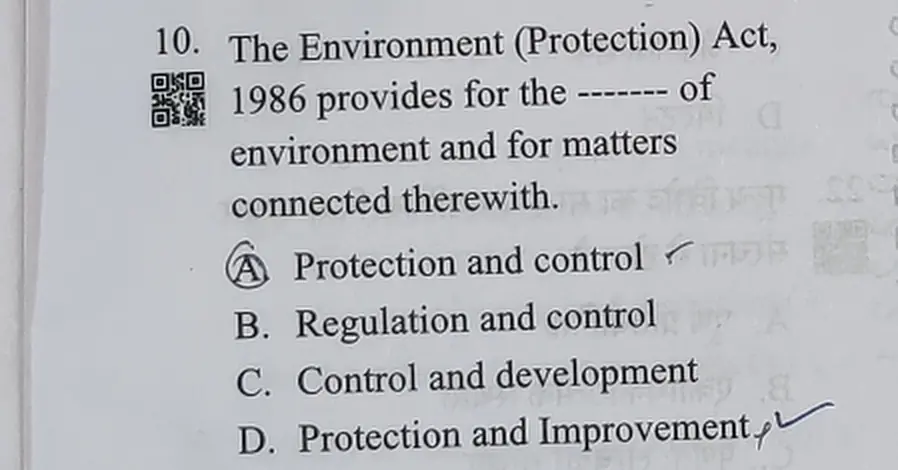
Why? explanation for all 4 options
- ✗A."Protection and control" is not the exact wording of the Act's stated purpose.
- ✗B."Regulation and control" does not match the Act's actual long-title wording.
- ✗C."Control and development" does not match the Act's actual long-title wording.
- ✓D.Correct — the Environment (Protection) Act, 1986's long title states it is "to provide for the protection and improvement of environment".
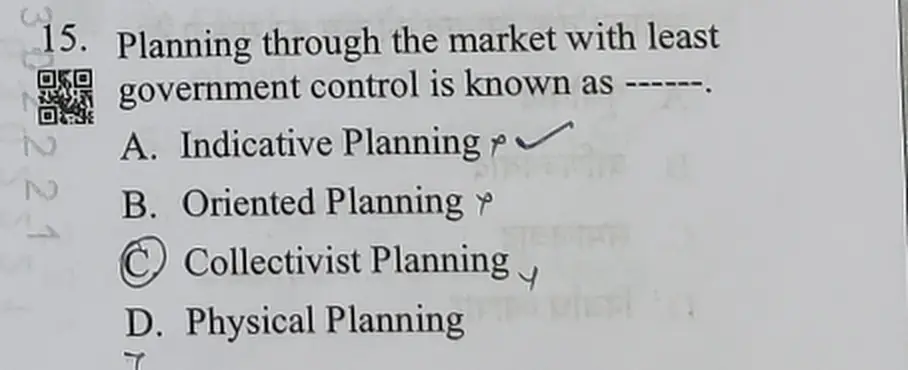
Why? explanation for all 4 options
- ✓A.Correct — planning through the market mechanism with minimal government control/direction is known as Indicative Planning.
- ✗B."Oriented Planning" is not a standard, recognised planning-type term in this context.
- ✗C.Collectivist Planning involves centralised state control (opposite of market-led, minimal-control planning).
- ✗D.Physical Planning sets output/production targets directly rather than working through market signals — the opposite approach described here.
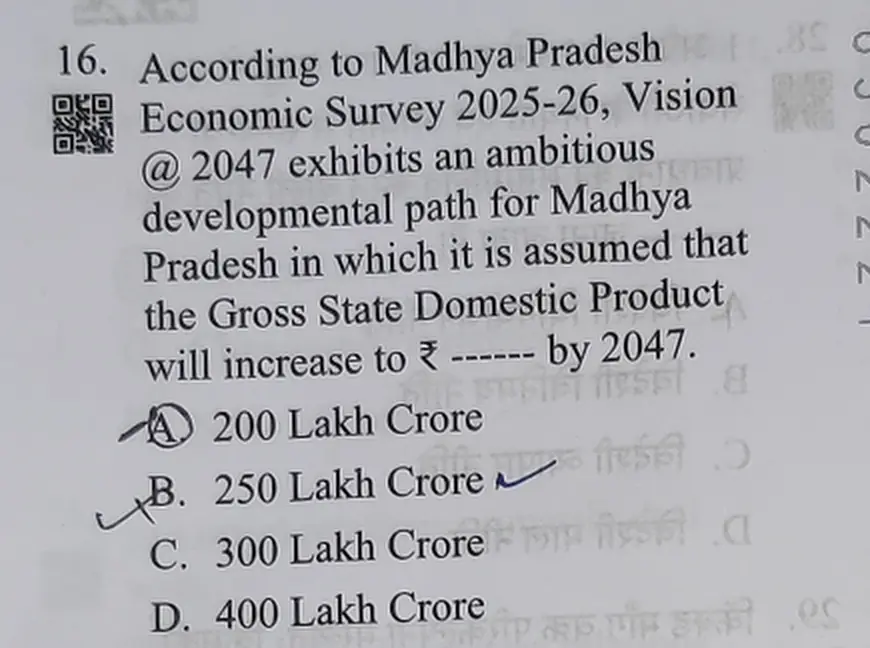
Why? explanation for all 4 options
- ✗A.200 Lakh Crore understates the Vision@2047 GSDP target cited in the MP Economic Survey 2025-26.
- ✓B.Correct — Madhya Pradesh's Vision@2047 projects GSDP reaching roughly ₹250 Lakh Crore (≈₹248.6 Lakh Crore) by 2047-48, per the state's economic planning documents.
- ✗C.300 Lakh Crore overstates the cited Vision@2047 GSDP target.
- ✗D.400 Lakh Crore substantially overstates the cited Vision@2047 GSDP target.
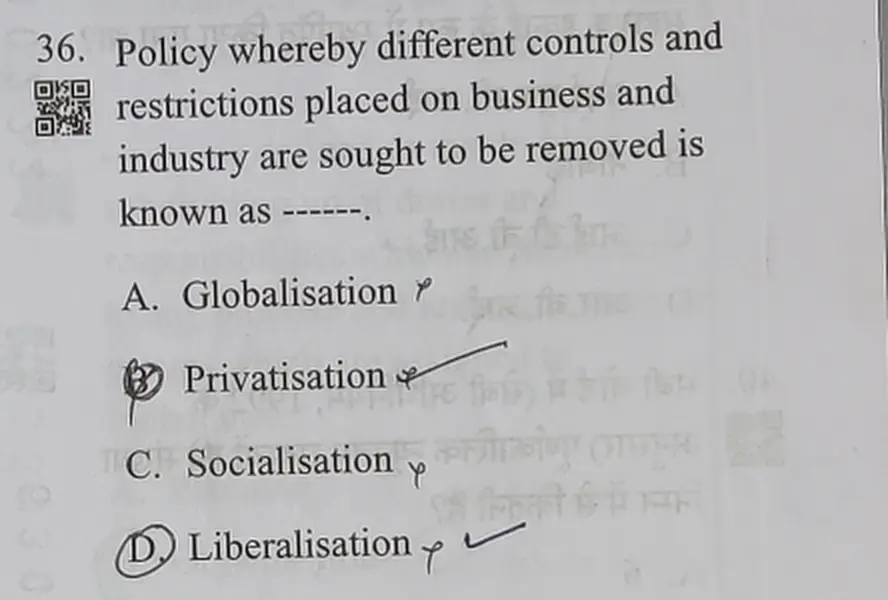
Why? explanation for all 4 options
- ✗A.Globalisation is about integrating with the world economy, not specifically about removing domestic controls/restrictions.
- ✗B.Privatisation means transferring ownership from government to private players — a different process from removing controls/restrictions generally.
- ✗C.Socialisation would mean increasing state control, the opposite of what the question describes.
- ✓D.Correct — Liberalisation specifically means removing/relaxing government controls and restrictions placed on business and industry.
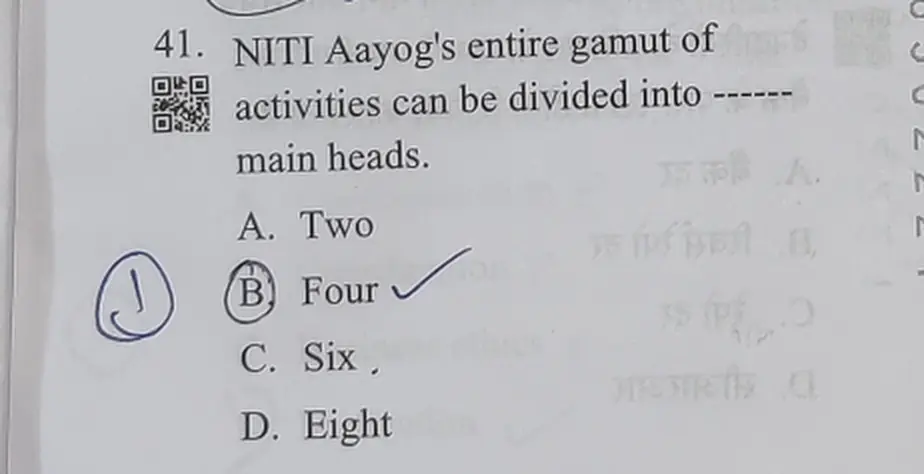
Why? explanation for all 4 options
- ✗A."Two" understates the number of main heads NITI Aayog's activities are divided into.
- ✓B.Correct — NITI Aayog's scope of activities is divided into four main heads: policy/programme framework design, fostering cooperative federalism, monitoring & evaluation, and acting as a think-tank/knowledge hub.
- ✗C."Six" overstates the number of main heads.
- ✗D."Eight" overstates the number of main heads.
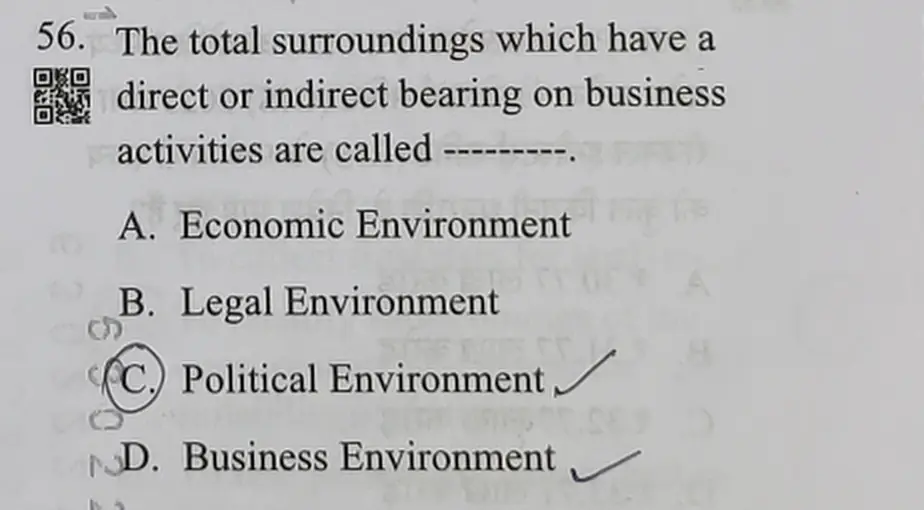
Why? explanation for all 4 options
- ✗A.Economic Environment is only one component (interest rates, inflation, etc.), not the full "total surroundings" described.
- ✗B.Legal Environment is only one component (laws, regulations), not the complete surroundings described.
- ✗C.Political Environment is only one component (government stability, policy), not the complete surroundings described.
- ✓D.Correct — "Business Environment" is the umbrella term for the total surroundings — all factors, internal and external — that have a direct or indirect bearing on business activities.
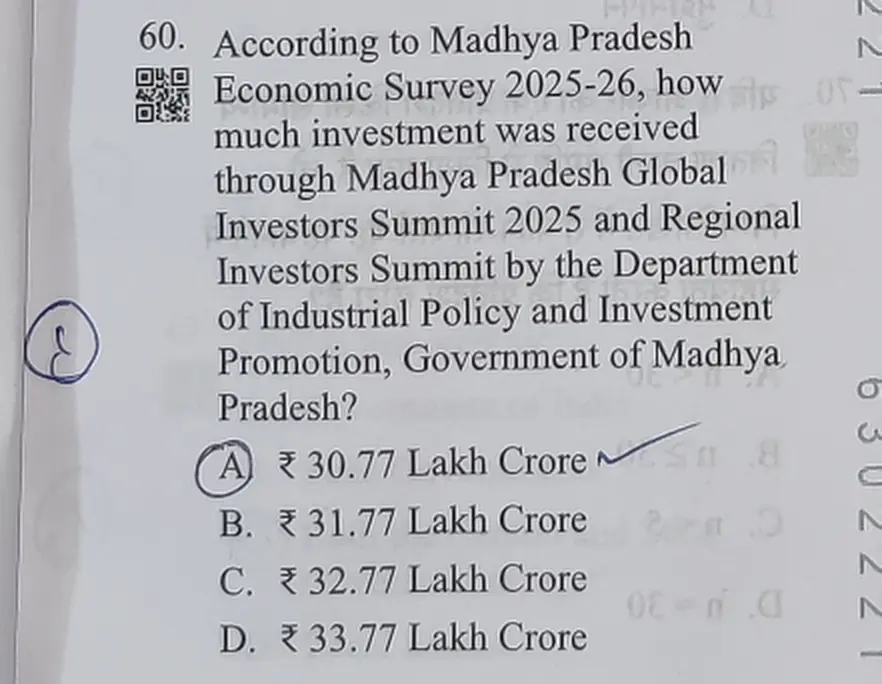
Why? explanation for all 4 options
- ✓A.Correct — per Madhya Pradesh's Economic Survey 2025-26, the combined investment proposals received through the Global Investors Summit 2025 and the Regional Investors Summits were about ₹30.77 Lakh Crore.
- ✗B.₹31.77 Lakh Crore is not the figure cited in the state's Economic Survey.
- ✗C.₹32.77 Lakh Crore is not the figure cited in the state's Economic Survey.
- ✗D.₹33.77 Lakh Crore is not the figure cited in the state's Economic Survey.
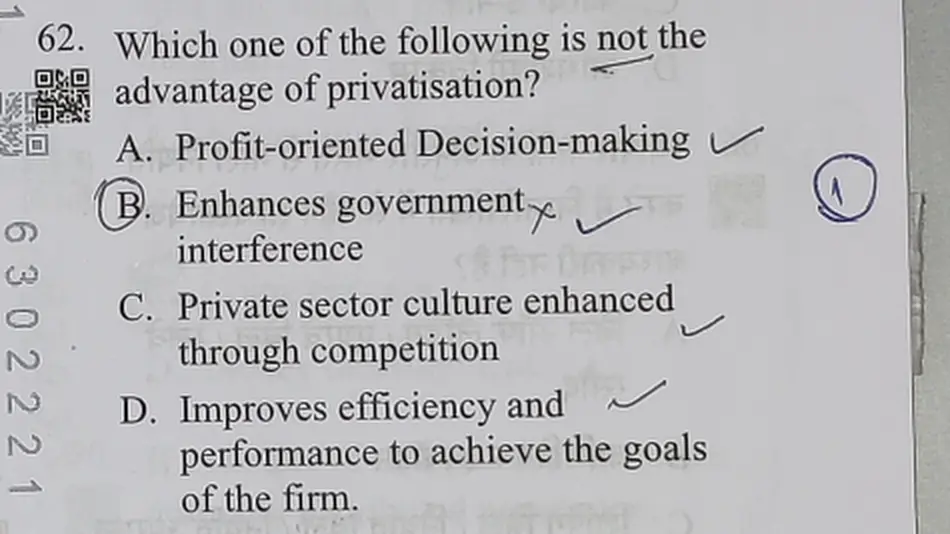
Why? explanation for all 4 options
- ✗A.Profit-oriented decision-making is a genuine advantage claimed for privatisation (efficiency-driven management).
- ✓B.Correct — privatisation is meant to reduce, not enhance, government interference in business decisions, so "enhances government interference" is not an advantage of privatisation — it describes the opposite effect.
- ✗C.A stronger private-sector culture through competition is a genuine advantage claimed for privatisation.
- ✗D.Improved efficiency and performance is a genuine advantage claimed for privatisation.
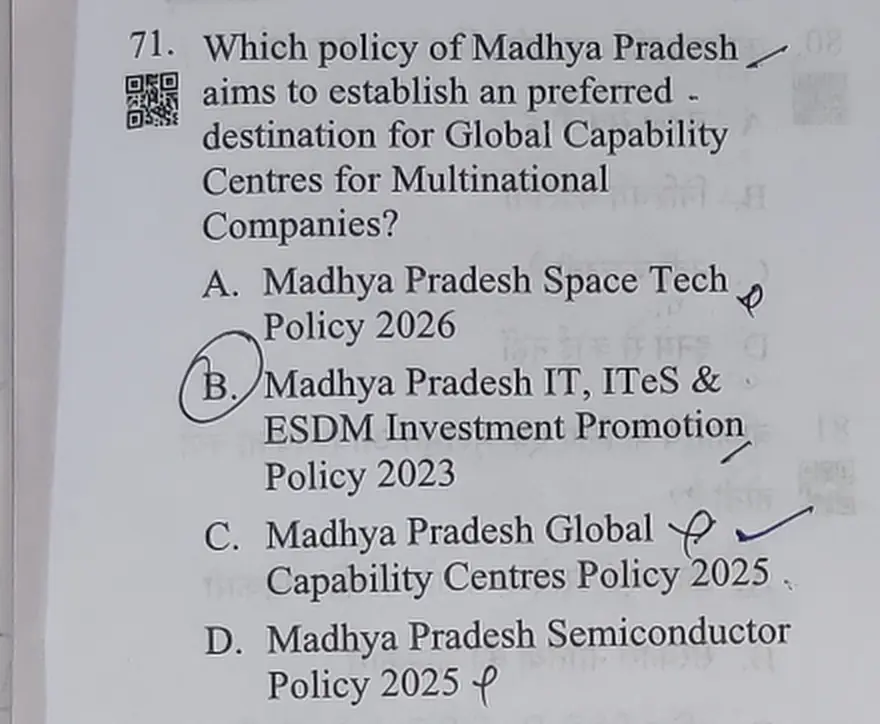
Why? explanation for all 4 options
- ✗A.The Madhya Pradesh Space Tech Policy targets the space/aerospace sector, not Global Capability Centres.
- ✗B.The MP IT, ITeS & ESDM Investment Promotion Policy (2023) covers IT/electronics investment broadly; it is not the state's dedicated GCC policy.
- ✓C.Correct — Madhya Pradesh launched the Global Capability Centres (GCC) Policy, 2025 — reported as India's first dedicated state GCC policy — specifically to attract GCCs set up by multinational companies.
- ✗D.The Madhya Pradesh Semiconductor Policy targets the semiconductor manufacturing sector, not Global Capability Centres.
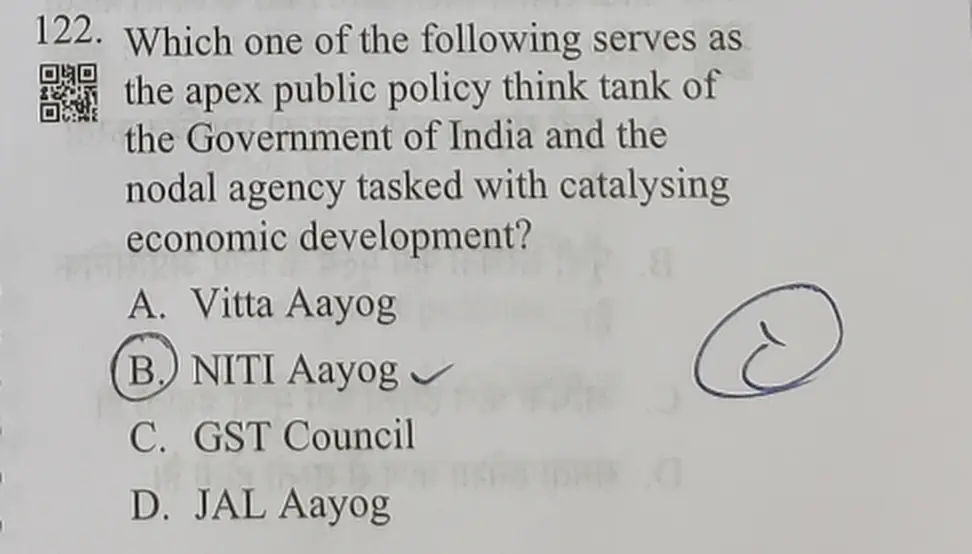
Why? explanation for all 4 options
- ✗A."Vitta Aayog" is not an existing body — it appears to be a distractor built on the Hindi word for "finance" (vitta).
- ✓B.Correct — NITI Aayog describes itself as the Government of India's premier public policy think tank and the nodal agency for catalysing economic development.
- ✗C.The GST Council administers Goods and Services Tax policy; it is not a general public-policy think tank.
- ✗D."JAL Aayog" is not the Government of India's apex public policy think tank — it is a distractor based on the Hindi word for "water" (jal).
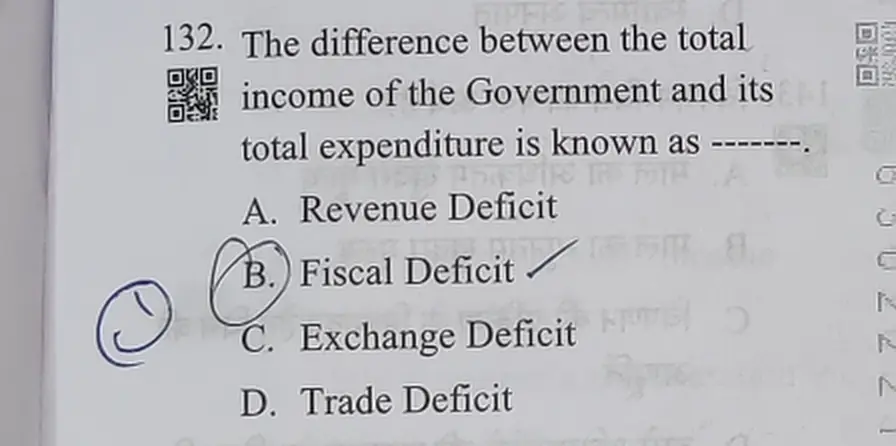
Why? explanation for all 4 options
- ✗A.Revenue Deficit is the gap between revenue expenditure and revenue receipts specifically, not the broader income-expenditure gap described here.
- ✓B.Correct — Fiscal Deficit is the difference between the government's total expenditure and its total income (receipts), representing its total borrowing requirement.
- ✗C."Exchange Deficit" is not a standard government-finance term for this concept.
- ✗D.Trade Deficit refers to imports exceeding exports in external trade, not the government's overall income-expenditure gap.
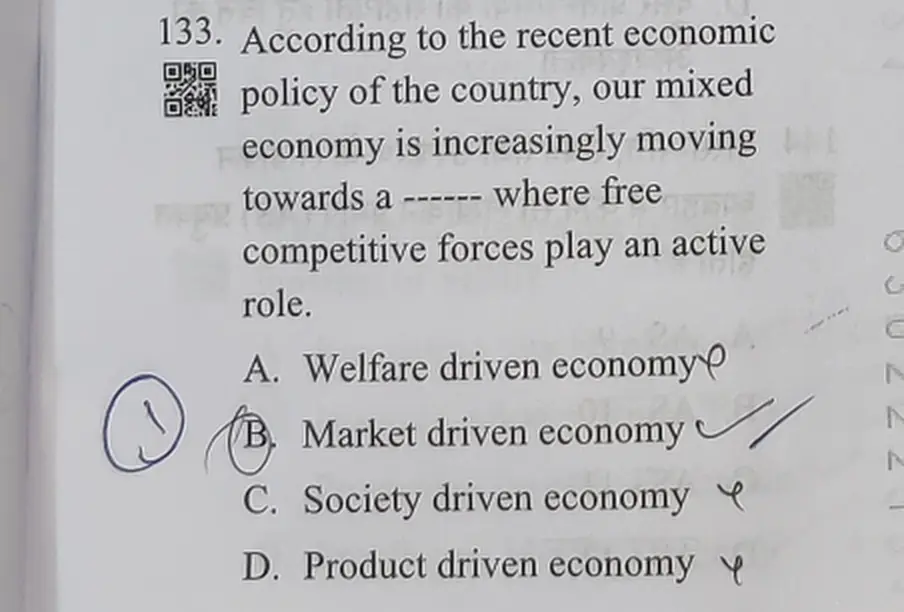
Why? explanation for all 4 options
- ✗A.A "welfare driven economy" emphasises state-led social welfare, not an increasing role for free competitive market forces.
- ✓B.Correct — India's mixed economy has been moving towards a more market-driven economy, where competitive market forces play an increasingly active role (post-1991 liberalisation trend).
- ✗C."Society driven economy" is not a standard economic-system term matching this description.
- ✗D."Product driven economy" is not a standard economic-system term matching this description.
Final Answer Keys
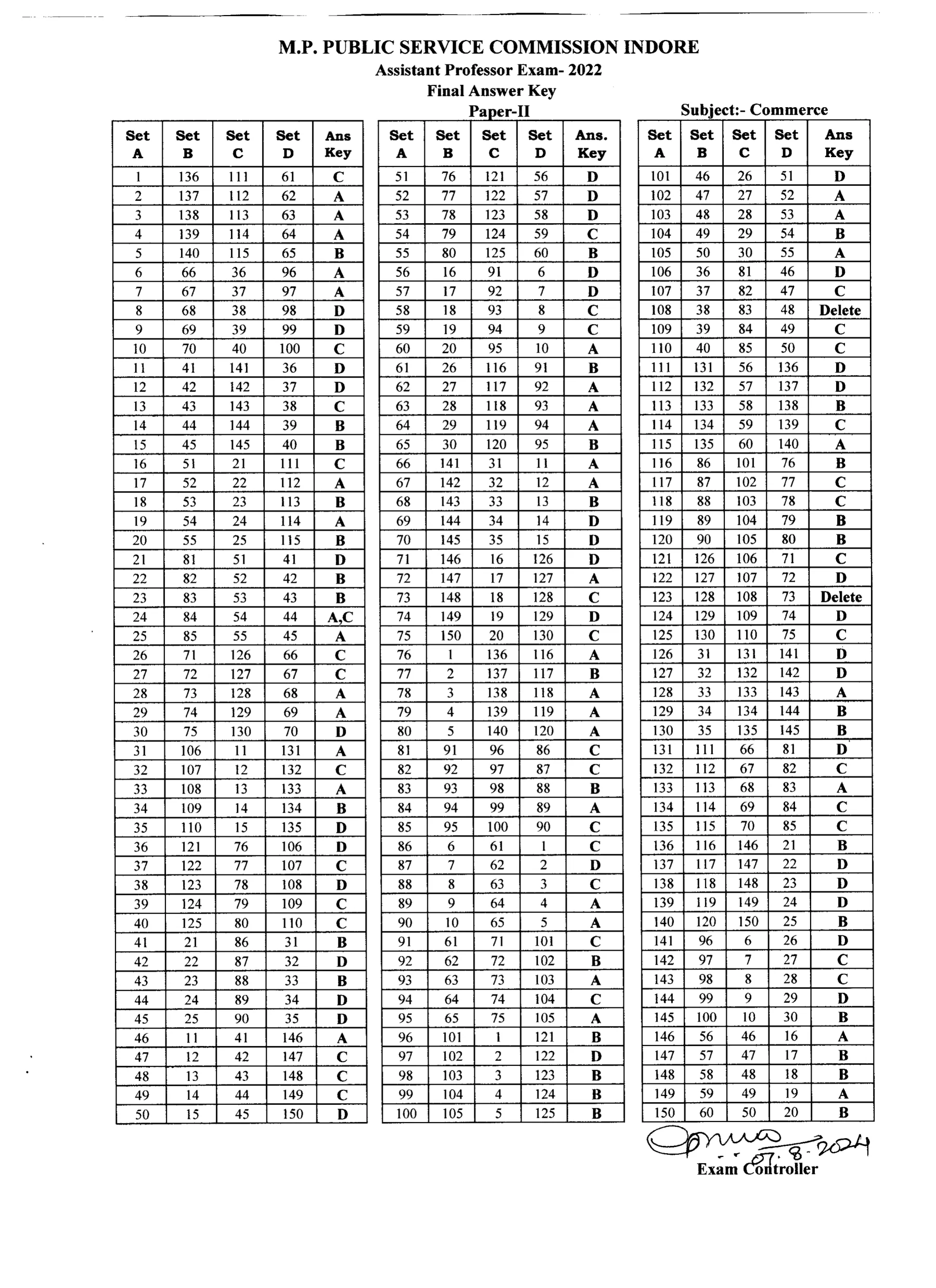
AP Exam 2022 (Held 9 Jun 2024) — Set D — Final Answer Key
150 questions · in question orderAnswers as per the M.P. Public Service Commission Final Answer Key (Assistant Professor Exam-2022, held 9 June 2024, Commerce, Paper-II), SET-D column only — this booklet is Set D. Where the key accepts two options both are shown; two questions were deleted by the Commission. Click a question number to open that question in its unit.
| Q. | Ans. | Unit |
|---|---|---|
| 1 | C | VII |
| 2 | D | VII |
| 3 | C | VII |
| 4 | A | VII |
| 5 | A | VII |
| 6 | D | III |
| 7 | D | III |
| 8 | C | III |
| 9 | C | III |
| 10 | A | III |
| 11 | A | X |
| 12 | A | X |
| 13 | B | X |
| 14 | D | X |
| 15 | D | X |
| 16 | A | V |
| 17 | B | V |
| 18 | B | V |
| 19 | A | V |
| 20 | B | V |
| 21 | B | VIII |
| 22 | D | VIII |
| 23 | D | VIII |
| 24 | D | VIII |
| 25 | B | VIII |
| 26 | D | II |
| 27 | C | II |
| 28 | C | II |
| 29 | D | II |
| 30 | B | II |
| Q. | Ans. | Unit |
|---|---|---|
| 31 | B | II |
| 32 | D | II |
| 33 | B | II |
| 34 | D | IV |
| 35 | D | IV |
| 36 | D | VII |
| 37 | D | VII |
| 38 | C | VII |
| 39 | B | VII |
| 40 | B | VII |
| 41 | D | I |
| 42 | B | V |
| 43 | B | I |
| 44 | A, C | I |
| 45 | A | I |
| 46 | D | III |
| 47 | C | X |
| 48 | Deleted | X |
| 49 | C | X |
| 50 | C | X |
| 51 | D | III |
| 52 | A | III |
| 53 | A | III |
| 54 | B | III |
| 55 | A | III |
| 56 | D | VIII |
| 57 | D | VIII |
| 58 | D | VIII |
| 59 | C | VIII |
| 60 | B | VIII |
| Q. | Ans. | Unit |
|---|---|---|
| 61 | C | II |
| 62 | A | II |
| 63 | A | II |
| 64 | A | II |
| 65 | B | II |
| 66 | C | VII |
| 67 | C | VII |
| 68 | A | VII |
| 69 | A | VII |
| 70 | D | VII |
| 71 | C | V |
| 72 | D | V |
| 73 | Deleted | V |
| 74 | D | V |
| 75 | C | V |
| 76 | B | IX |
| 77 | C | IX |
| 78 | C | IX |
| 79 | B | IX |
| 80 | B | IX |
| 81 | D | III |
| 82 | C | III |
| 83 | A | III |
| 84 | C | III |
| 85 | C | III |
| 86 | C | VIII |
| 87 | C | VIII |
| 88 | B | VIII |
| 89 | A | VIII |
| 90 | C | VIII |
| Q. | Ans. | Unit |
|---|---|---|
| 91 | B | VI |
| 92 | A | VI |
| 93 | A | VI |
| 94 | A | VI |
| 95 | B | VI |
| 96 | A | IV |
| 97 | A | IV |
| 98 | D | IV |
| 99 | D | IV |
| 100 | C | II |
| 101 | C | I |
| 102 | B | I |
| 103 | A | I |
| 104 | C | I |
| 105 | A | I |
| 106 | D | II |
| 107 | C | II |
| 108 | D | II |
| 109 | C | II |
| 110 | C | II |
| 111 | C | IX |
| 112 | A | IX |
| 113 | B | IX |
| 114 | A | IX |
| 115 | B | IX |
| 116 | A | V |
| 117 | B | V |
| 118 | A | V |
| 119 | A | V |
| 120 | A | V |
| Q. | Ans. | Unit |
|---|---|---|
| 121 | B | VI |
| 122 | D | VI |
| 123 | B | VI |
| 124 | B | VI |
| 125 | B | V |
| 126 | D | IV |
| 127 | A | IV |
| 128 | C | IV |
| 129 | D | IV |
| 130 | C | IV |
| 131 | A | X |
| 132 | C | X |
| 133 | A | X |
| 134 | B | X |
| 135 | D | X |
| 136 | D | VI |
| 137 | D | VI |
| 138 | B | VI |
| 139 | C | VI |
| 140 | A | VI |
| 141 | D | I |
| 142 | D | I |
| 143 | A | I |
| 144 | B | I |
| 145 | B | I |
| 146 | A | IX |
| 147 | C | IX |
| 148 | C | IX |
| 149 | C | IX |
| 150 | D | IX |
Original key as published (all four sets — this page uses the SET-D column; click to enlarge)
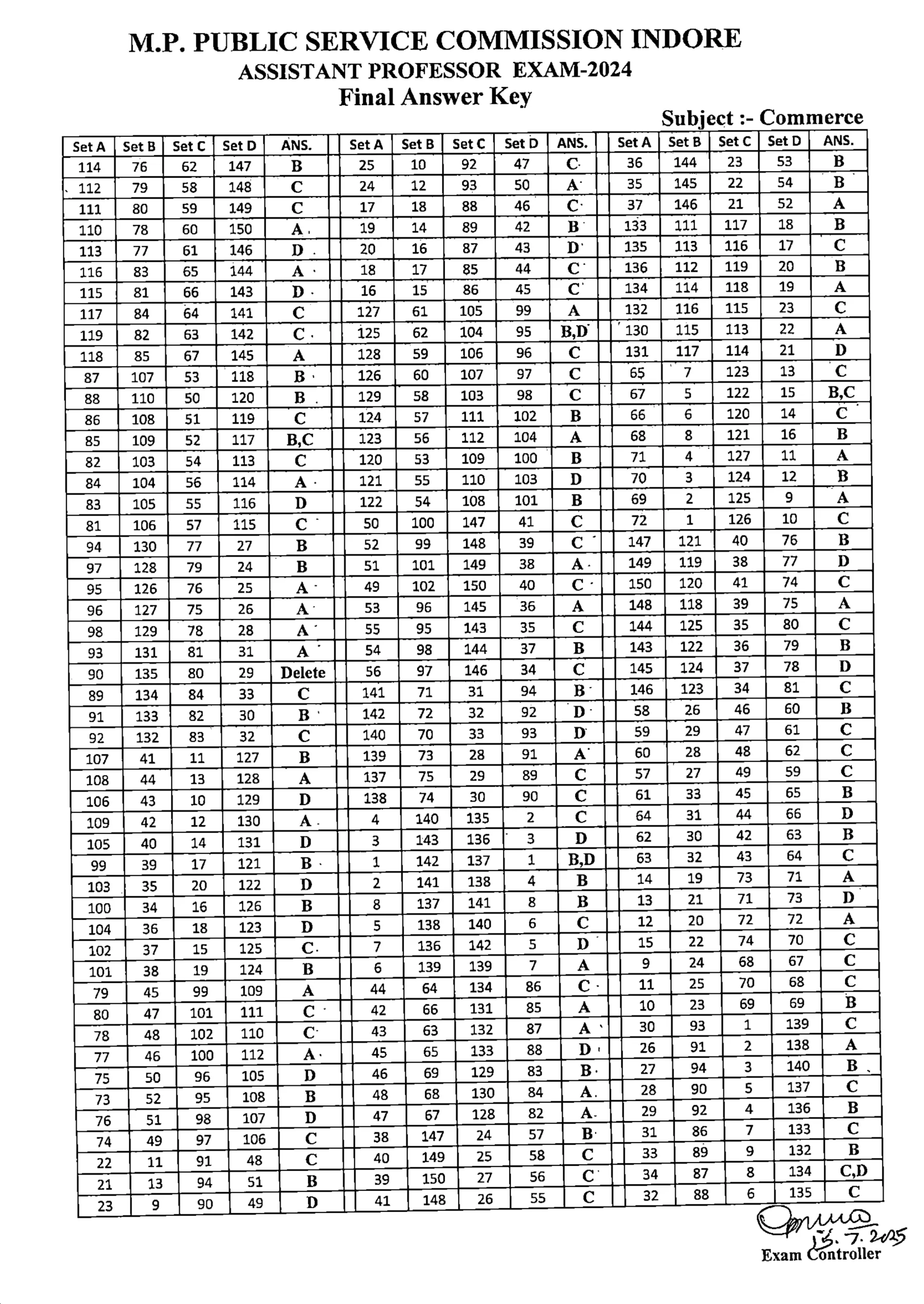
AP Exam 2024 (Held 1 Jun 2025) — Set C — Final Answer Key
150 questions · in question orderAnswers as per the M.P. Public Service Commission Final Answer Key (Assistant Professor Exam-2024, held 1 June 2025, Commerce), SET-C column only — this booklet is Set C. Where the key accepts two options both are shown; one question was deleted by the Commission. Click a question number to open that question in its unit.
| Q. | Ans. | Unit |
|---|---|---|
| 1 | C | X |
| 2 | A | X |
| 3 | B | X |
| 4 | B | X |
| 5 | C | X |
| 6 | C | X |
| 7 | C | X |
| 8 | C, D | X |
| 9 | B | X |
| 10 | D | III |
| 11 | B | II |
| 12 | A | III |
| 13 | A | IV |
| 14 | D | III |
| 15 | C | III |
| 16 | B | III |
| 17 | B | III |
| 18 | D | III |
| 19 | B | III |
| 20 | D | III |
| 21 | A | VII |
| 22 | B | VII |
| 23 | B | VII |
| 24 | B | VII |
| 25 | C | VII |
| 26 | C | VII |
| 27 | C | VII |
| 28 | A | VI |
| 29 | C | VI |
| 30 | C | VI |
| Q. | Ans. | Unit |
|---|---|---|
| 31 | B | VI |
| 32 | D | VI |
| 33 | D | VI |
| 34 | C | IX |
| 35 | C | IX |
| 36 | B | IX |
| 37 | D | IX |
| 38 | D | VIII |
| 39 | A | IX |
| 40 | B | VIII |
| 41 | C | I |
| 42 | B | IX |
| 43 | C | IX |
| 44 | D | IX |
| 45 | B | IX |
| 46 | B | IX |
| 47 | C | IX |
| 48 | C | IX |
| 49 | C | IX |
| 50 | B | I |
| 51 | C | IX |
| 52 | B, C | I |
| 53 | B | I |
| 54 | C | I |
| 55 | D | II |
| 56 | A | II |
| 57 | C | II |
| 58 | C | I |
| 59 | C | I |
| 60 | A | I |
| Q. | Ans. | Unit |
|---|---|---|
| 61 | D | I |
| 62 | B | I |
| 63 | C | I |
| 64 | C | I |
| 65 | A | I |
| 66 | D | I |
| 67 | A | I |
| 68 | C | X |
| 69 | B | X |
| 70 | C | X |
| 71 | D | X |
| 72 | A | X |
| 73 | A | IX |
| 74 | C | X |
| 75 | A | II |
| 76 | A | II |
| 77 | B | II |
| 78 | A | II |
| 79 | B | II |
| 80 | Deleted | II |
| 81 | A | VII |
| 82 | B | II |
| 83 | C | II |
| 84 | C | IV |
| 85 | C | IV |
| 86 | C | IV |
| 87 | D | IV |
| 88 | C | IV |
| 89 | B | IV |
| 90 | D | IV |
| Q. | Ans. | Unit |
|---|---|---|
| 91 | C | IV |
| 92 | C | IV |
| 93 | A | IV |
| 94 | B | IV |
| 95 | B | III |
| 96 | D | III |
| 97 | C | IV |
| 98 | D | IV |
| 99 | A | III |
| 100 | A | III |
| 101 | C | III |
| 102 | C | III |
| 103 | C | V |
| 104 | B, D | II |
| 105 | A | IV |
| 106 | C | II |
| 107 | C | V |
| 108 | B | V |
| 109 | B | V |
| 110 | D | V |
| 111 | B | V |
| 112 | A | V |
| 113 | A | VIII |
| 114 | D | VIII |
| 115 | C | VIII |
| 116 | C | VII |
| 117 | B | VII |
| 118 | A | VIII |
| 119 | B | VIII |
| 120 | C | VIII |
| Q. | Ans. | Unit |
|---|---|---|
| 121 | B | VIII |
| 122 | B, C | VIII |
| 123 | C | VIII |
| 124 | B | VIII |
| 125 | A | VIII |
| 126 | C | VIII |
| 127 | A | VIII |
| 128 | A | VII |
| 129 | B | VII |
| 130 | A | VII |
| 131 | A | VII |
| 132 | A | VII |
| 133 | D | VII |
| 134 | C | VI |
| 135 | C | VI |
| 136 | D | VI |
| 137 | B, D | VI |
| 138 | B | VI |
| 139 | A | VI |
| 140 | C | VI |
| 141 | B | VI |
| 142 | D | VI |
| 143 | C | V |
| 144 | B | V |
| 145 | A | V |
| 146 | C | V |
| 147 | C | V |
| 148 | C | V |
| 149 | A | V |
| 150 | C | V |
Original key as published (all four sets — this page uses the SET-C column; click to enlarge)
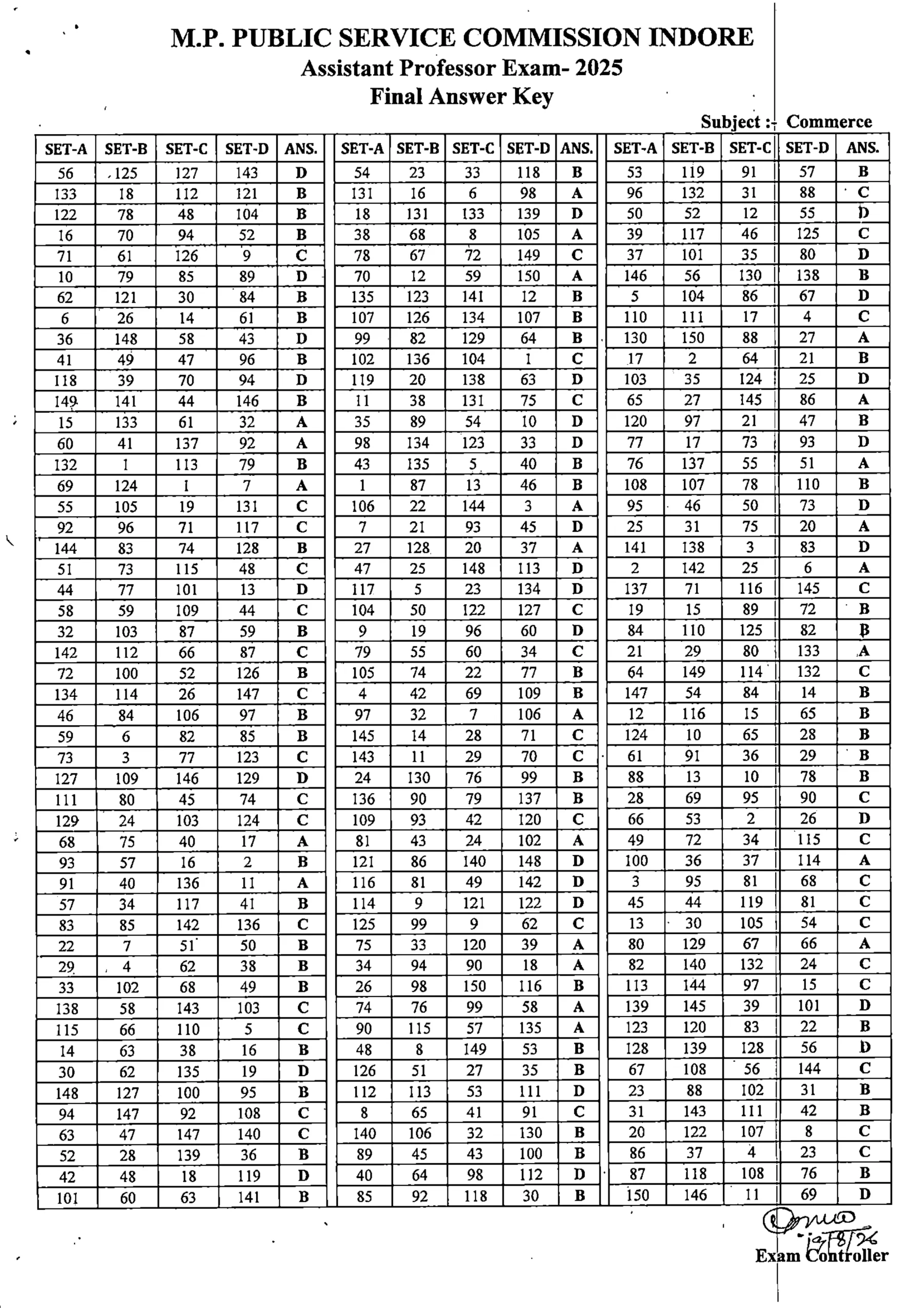
AP Exam 2025 (Held 2 Aug 2026) — Set A — Final Answer Key
150 questions · in question orderAnswers as per the M.P. Public Service Commission Final Answer Key (Assistant Professor Exam 2025, held 2 August 2026, Commerce), SET-A column only. Click a question number to open that question in its unit.
| Q. | Ans. | Unit |
|---|---|---|
| 1 | B | V |
| 2 | A | VIII |
| 3 | C | IX |
| 4 | B | VI |
| 5 | D | VIII |
| 6 | B | VII |
| 7 | D | V |
| 8 | C | VII |
| 9 | D | V |
| 10 | D | I |
| 11 | C | V |
| 12 | B | IX |
| 13 | C | X |
| 14 | B | III |
| 15 | A | I |
| 16 | B | I |
| 17 | B | VIII |
| 18 | D | IV |
| 19 | B | IX |
| 20 | C | X |
| 21 | A | IX |
| 22 | B | III |
| 23 | B | X |
| 24 | B | VI |
| 25 | A | VIII |
| 26 | B | VI |
| 27 | A | V |
| 28 | C | IX |
| 29 | B | III |
| 30 | D | III |
| Q. | Ans. | Unit |
|---|---|---|
| 31 | B | X |
| 32 | B | II |
| 33 | B | III |
| 34 | A | VI |
| 35 | D | V |
| 36 | D | I |
| 37 | D | VII |
| 38 | A | IV |
| 39 | C | VII |
| 40 | D | VII |
| 41 | B | I |
| 42 | D | IV |
| 43 | B | V |
| 44 | D | II |
| 45 | C | X |
| 46 | B | II |
| 47 | D | V |
| 48 | B | VII |
| 49 | C | IX |
| 50 | D | VII |
| 51 | C | II |
| 52 | B | IV |
| 53 | B | VII |
| 54 | B | IV |
| 55 | C | II |
| 56 | D | I |
| 57 | B | III |
| 58 | C | II |
| 59 | B | II |
| 60 | A | I |
| Q. | Ans. | Unit |
|---|---|---|
| 61 | B | IX |
| 62 | B | I |
| 63 | C | IV |
| 64 | C | IX |
| 65 | A | VIII |
| 66 | D | IX |
| 67 | C | X |
| 68 | A | III |
| 69 | A | II |
| 70 | A | IV |
| 71 | C | I |
| 72 | B | II |
| 73 | C | II |
| 74 | A | VII |
| 75 | A | VI |
| 76 | A | VIII |
| 77 | D | VIII |
| 78 | C | IV |
| 79 | C | V |
| 80 | A | X |
| 81 | A | VI |
| 82 | C | X |
| 83 | C | III |
| 84 | B | IX |
| 85 | B | VII |
| 86 | C | X |
| 87 | B | X |
| 88 | B | IX |
| 89 | B | VII |
| 90 | A | VII |
| Q. | Ans. | Unit |
|---|---|---|
| 91 | A | III |
| 92 | C | II |
| 93 | B | III |
| 94 | C | IV |
| 95 | D | VIII |
| 96 | C | VII |
| 97 | A | VI |
| 98 | D | V |
| 99 | B | IV |
| 100 | A | IX |
| 101 | B | IV |
| 102 | C | IV |
| 103 | D | VIII |
| 104 | C | V |
| 105 | B | V |
| 106 | A | V |
| 107 | B | IV |
| 108 | B | VIII |
| 109 | C | VI |
| 110 | C | VIII |
| 111 | C | III |
| 112 | D | VII |
| 113 | C | X |
| 114 | D | V |
| 115 | C | III |
| 116 | D | VI |
| 117 | D | V |
| 118 | D | V |
| 119 | D | V |
| 120 | B | VIII |
| Q. | Ans. | Unit |
|---|---|---|
| 121 | D | VI |
| 122 | B | I |
| 123 | B | X |
| 124 | B | IX |
| 125 | C | VI |
| 126 | B | VII |
| 127 | D | II |
| 128 | D | X |
| 129 | C | III |
| 130 | A | VIII |
| 131 | A | IV |
| 132 | B | I |
| 133 | B | I |
| 134 | C | II |
| 135 | B | IV |
| 136 | B | VI |
| 137 | C | IX |
| 138 | C | III |
| 139 | D | X |
| 140 | B | VII |
| 141 | D | VIII |
| 142 | C | II |
| 143 | C | VI |
| 144 | B | II |
| 145 | C | VI |
| 146 | B | VIII |
| 147 | B | IX |
| 148 | B | III |
| 149 | B | VII |
| 150 | D | X |
Original key as published (all four sets — this page uses the SET-A column; click to enlarge)
Exam-Cycle & Weightage Analysis
Overall unit-wise PYQ frequency & weightage
Cycles asked & average questions per cycle
Swipe the chart sideways to see all of it →
Highest vs. lowest questions in a single cycle
Swipe the chart sideways to see all of it →
Unit-wise trend across the 3 chronological cycles
Exam cycle × unit heatmap (hover a cell for exact count & %)
Master unit-wise weightage table
| Unit | Total PYQs | Overall % | Cycles Asked | % Cycles | Avg/Cycle | Median | Highest | Lowest | Range | Std Dev | Rank (Total) | Rank (Consistency) | Trend |
|---|---|---|---|---|---|---|---|---|---|---|---|---|---|
| Unit I Business Environment |
41 | 9.11% | 3/3 | 100.00% | 13.7 | 14 | 15 | 12 | 3 | 1.2 | #9 | #8 | Insufficient data |
| Unit II Accounting |
48 | 10.67% | 3/3 | 100.00% | 16.0 | 15 | 19 | 14 | 5 | 2.2 | #2 | #9 | Insufficient data |
| Unit III Business Economics |
46 | 10.22% | 3/3 | 100.00% | 15.3 | 15 | 16 | 15 | 1 | 0.5 | #4 | #3 | Insufficient data |
| Unit IV Business Statistics and Data Processing |
41 | 9.11% | 3/3 | 100.00% | 13.7 | 15 | 15 | 11 | 4 | 1.9 | #10 | #10 | Insufficient data |
| Unit V Business Management and Business Laws |
49 | 10.89% | 3/3 | 100.00% | 16.3 | 17 | 17 | 15 | 2 | 0.9 | #1 | #7 | Insufficient data |
| Unit VI Marketing Management |
43 | 9.56% | 3/3 | 100.00% | 14.3 | 14 | 15 | 14 | 1 | 0.5 | #8 | #5 | Insufficient data |
| Unit VII Financial Management and Financial Institutions |
48 | 10.67% | 3/3 | 100.00% | 16.0 | 16 | 17 | 15 | 2 | 0.8 | #3 | #6 | Insufficient data |
| Unit VIII Human Resource Management |
45 | 10.00% | 3/3 | 100.00% | 15.0 | 15 | 15 | 15 | 0 | 0.0 | #5 | #1 | Insufficient data |
| Unit IX International Business |
45 | 10.00% | 3/3 | 100.00% | 15.0 | 15 | 15 | 15 | 0 | 0.0 | #6 | #2 | Insufficient data |
| Unit X Taxation and Tax Planning |
44 | 9.78% | 3/3 | 100.00% | 14.7 | 15 | 15 | 14 | 1 | 0.5 | #7 | #4 | Insufficient data |
Exam-cycle inventory (unit-wise question counts per cycle)
| # | Exam Cycle (date · shift) | Total Q | I | II | III | IV | V | VI | VII | VIII | IX | X | Verified |
|---|---|---|---|---|---|---|---|---|---|---|---|---|---|
| 1 | AP Exam 2022 (Held 9 Jun 2024) — Set D | 150 | 14 | 19 | 16 | 11 | 17 | 14 | 15 | 15 | 15 | 14 | ✓ |
| 2 | AP Exam 2024 (Held 1 Jun 2025) — Set C | 150 | 15 | 14 | 15 | 15 | 15 | 15 | 16 | 15 | 15 | 15 | ✓ |
| 3 | AP Exam 2025 (Held 2 Aug 2026) — Set A | 150 | 12 | 15 | 15 | 15 | 17 | 14 | 17 | 15 | 15 | 15 | ✓ |